



Hurricane Polo has now made landfall on the west coast of Baja California Sur, Mexico with sustained winds of 110 mph and a minimum central pressure of 965mb, at which level there is no threat to the parametric trigger of the Mexican governments $175 million IBRD CAR Mexico 2024 (Pacific) catastrophe bond.
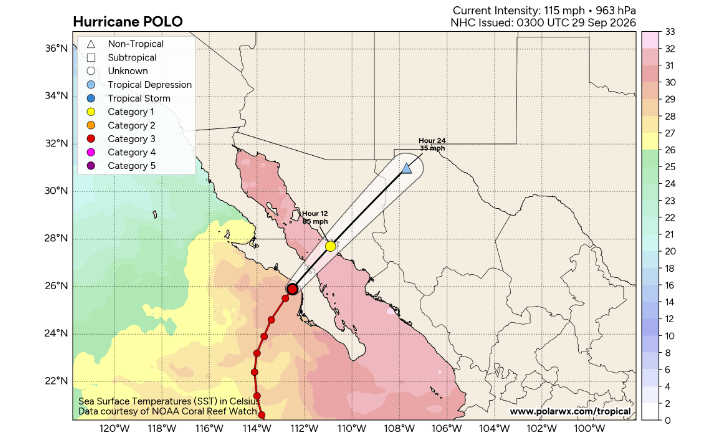 We documented hurricane Polo’s journey along the Mexican west coast in our previous article. While at times the central pressure of the storm dipped low enough to levels that could have triggered the Mexico Pacific named storm catastrophe bond, at no time did the centre of the storm cross a parametric trigger zone.
However, there was meaningful uncertainty as early in its intensification some of the forecast models had suggested hurricane Polo could turn towards the Mexican coastline as a significant Category 5 storm, at an intensity that could have triggered the cat bond.
But Polo remained offshore and took the main model forecast route towards the Baja peninsula, which is where it has now made landfall.
The catastrophe bond market saw bid/ask spreads for the Mexico IBRD Pacific coast named storm cat bond widen with the uncertainty surrounding hurricane Polo’s path and fluctuations in intensity.
But as the forecast unfolded and it became more certain that Polo would remain offshore at its peak intensity, the uncertainty diminished and by the end of last week it was deemed more likely that the outcome we see today would be the eventual path, with risk to the parametric cat bond therefore reducing.
However, hurricane Polo has still made landfall on the Baja peninsula as a strong Category 2 hurricane with its 110 mph sustained winds and higher gusts.
As a result, for the region now being impacted this is still a significant event and there is a threat to lives and livelihoods.
The National Hurricane Center warns of life-threatening winds and flash flooding, with a storm surge expected and rainfall totals of 6 to 12 inches expected for the landfall region, sufficient to cause risk to life and property.
Hurricane Polo will now cross the Baja peninsula and make a second landfall in Sonora, where additional rainfall totals of up to 8 inches are forecast for southern and central portions of this region of Mexico.
Further ahead, the moisture plume created by this significant Pacific named storm will bring heavy rains into the southern United States as well.
Mexico’s catastrophe bond has been calibrated for its parametric trigger to respond to more intense hurricanes, where the need for disaster risk financing relief would be greater.
In order for the IBRD Pacific named storm cat bond to be triggered a storm must pass the parametric zone lines with central pressure at 937mb or lower, we understand.
Recall that, the $175 million of IBRD CAR Mexico 2024 (Pacific) parametric catastrophe bond notes feature a parametric trigger design that requires a hurricane to have a minimum central pressure at or below specific levels in order to trigger a payout if it moves across the parametric box.
Different areas of coastline have different payout factors attached to them as well, so location and intensity are the two key metrics for defining whether any payout will occur and those payouts can be from 25% of principal, right up to the full 100% or $175 million, depending on where any hurricane breaches the parametric box.
While there was meaningful uncertainty at times, the market watched the passage of hurricane Polo carefully and while bid-ask spreads did widen for the cat bond, at no time was there the kind of response you might expect if market participants had viewed the risk as particularly high.
While the cat bond has not been triggered it has acted as designed in this case. Mexico also has a parametric catastrophe insurance arrangement that provides around US $575 million of protection for 2026 into 2027.
That parametric insurance arrangement is understood to have lower trigger thresholds than the catastrophe bond, with the cat bond designed for the most extreme hurricane impacts. But it’s too early to know whether hurricane Polo may have activated it at this time.
The Mexican government has been a long-time buyer of parametric disaster risk transfer protection and has layered different coverages to respond at a range of intensities. With the IBRD cat bond looking to have avoided any impacts from Polo, it will remain in-force and available to provide payouts for Mexico for any future major hurricanes through the rest of its term.
 View all of our Artemis Live video interviews and subscribe to our podcast.
All of our Artemis Live insurance-linked securities (ILS), catastrophe bonds and reinsurance video content and video interviews can be accessed online.
Our Artemis Live podcast can be subscribed to using the typical podcast services providers, including Apple, Google, Spotify and more.