




Hurricane Isaias is now forecast to intensify further to become a major Category 3 storm as it approaches the Gulf Coast today, outpacing meteorologists initial expectations. But, prior to landfall late today or early on Saturday, Isaias is expected to encounter wind shear and begin to weaken, which should lessen the impacts and keeps estimates in the single-digit billions.
Hurricane Isaias has outpaced meteorologist expectations for a number of reasons. At first, when the depression was forming, many had said they did not anticipate the storm to form as quickly as it did. Now, having spent days forecasting a low-end Category 2 hurricane at Isaia’s peak, the forecasts have changed as Isaias has intensified a little more than anticipated.
Currently, as of the 06:00 UTC update from the National Hurricane Center, Isaias has maximum sustained winds of 105 mph, which puts it as a Category 2 storm at this time.
Hurricane Isaias has stronger gusts and a minimum central pressure that is estimated at 972mb, while the storm is currently around 230 miles south of the mouth of the Mississippi River.
Isaias is now forecast to move north-northeast and then turn to the north, before making landfall on the northern Gulf Coast late tonight, or early Saturday morning.
The NHC said, “Isaias could briefly become a major hurricane later today. Although some weakening is forecast thereafter, Isaias will remain a dangerous hurricane as it approaches the northern Gulf Coast tonight.”
The chart below from Tomer Burg’s PolarWx service shows the current NHC forecast including cone and wind speeds (this should update to show the latest hurricane information):
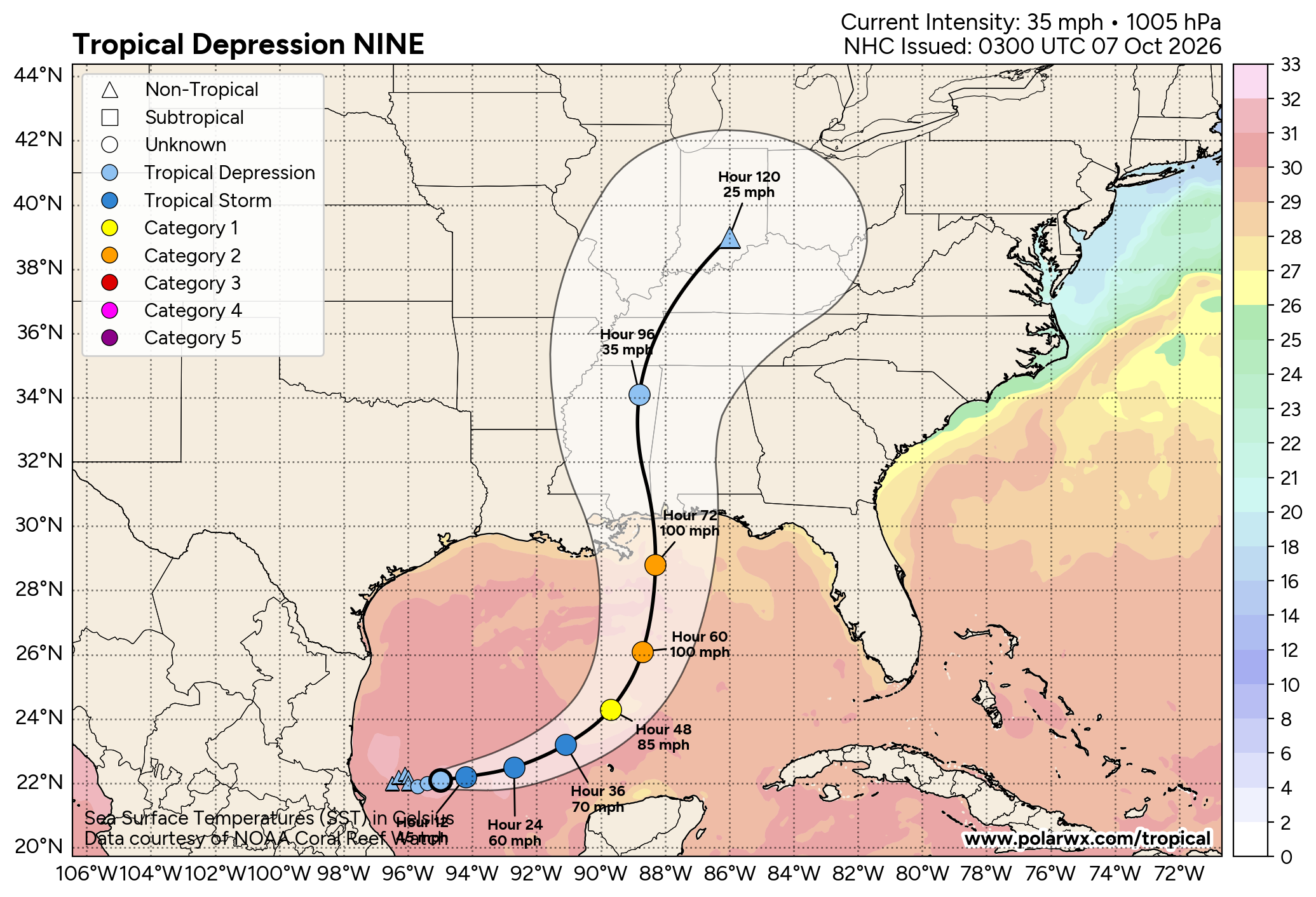
The latest forecast advisory data is still from 03:00 UTC, but that predicts hurricane Isaias will reach sustained winds of 100 knots, which would put it as a Category 3 major hurricane as it approaches landfall.
But, the forecast weakening is evident in the data as well, with sustained winds of just under 100 mph and gusts of around 120 mph expected just prior to landfall, hence this would be a low-end Category 2 landfall event if that turns out to be accurate.
Of course, hurricane Isaias has tended to outperform, so there is still some uncertainty. But wind shear is in its path and it is difficult to see it maintaining structure and so strength as it nears landfall, weakening does look backed in at this time.
The forecast storm surge remains for around 6 to 7 foot maximums, with the coastline between Dauphin Island, Alabama to Indian Pass, Florida expected to see the peak.
Localised rainfall totals of up to 15 inches, more widely 4 to 8 inches are also warned, while the threat of tornadoes as hurricane Isaias moves ashore and inland is also considered a risk.
The landfall location remains centered around Pensacola, Florida, in the far western Panhandle, according to the NHC forecast cone.
Given the landfall outlook remains for a Category 2 hurricane towards the lower-end, the outlook for the insurance market loss potential remains unchanged at this time as well.
Demonstrating the extent of the insured exposure in the path of hurricane Isaias, Cotality said that roughly 777,000 homes with a combined reconstruction cost value (RCV) of $241.6 billion are at risk of hurricane wind damage across eight counties under a Hurricane Warning, with 217,000 homes representing $65.2 billion in RCV facing potential storm surge threat.
Of course, that is just the level of exposure in potential harms way and in no way indicates the size of industry losses that are possible with hurricane Isaias.
In fact, reinsurance broker Gallagher Re said in its latest update that, “We maintain our expectation that insured losses, including private insurance carrier and National Flood Insurance Program (NFIP) claims payouts, will likely settle in the low- to mid-single-digit billions (USD). Given abundant reinsurance market capital, this event is unlikely to meaningfully influence upcoming January 1 reinsurance renewal discussions.”
Which continues to align with other market sources across reinsurance, catastrophe bonds and insurance-linked securities we’ve spoken with.
Late yesterday, Andrew Siffert of brokerage BMS Group concurred with a single-digit billion loss potential for hurricane Isaias, writing, “The landfall location, intensity, and overall structure of Isaias remain uncertain, but based on what we know, historical analogs like Hurricane Sally (2020), and catastrophe model runs, this would likely be a low single-digit billion-dollar loss for the insurance industry, with a range of $3B to $ 5B, with 80% of Category 1 events impacting the Mobile region resulting in losses below $3B of industry loss. Isaias will no doubt add to existing losses along the Gulf Coast in what is, overall, a historically low year for hurricane activity across the Atlantic Basin. For now, it does not seem this will materially affect current capacity or the softer market conditions in the U.S. property insurance market.”
Whether hurricane Isaias reaches Category 3 strength or not as it moves over the very warm Gulf waters, what really matters for the eventual insurance industry loss and any impact to reinsurance, cat bonds and ILS, is whether it follows the weakening trend that is anticipated as it nears the Gulf Coast.
A weakened low-end Cat 2 or even Cat 1 storm at landfall will mean a lower loss quantum, certainly only single digit billions. But, if Isaias should outperform again and makes landfall with higher wind speeds, then the costs could rise.
All of the main forecast models seem in agreement though, for this weakening to occur on approach.
There isn’t a great deal more to add, aside from it remains the case that some parametric insurance arrangements will be exposed to Isaias, especially at higher wind-speeds, while there is a chance of some losses flowing to reinsurance capital through lower-layer arrangements, quota shares including sidecars, while any aggregate structures exposed to Isaias could see deductible erosion.
At this stage, unless Isaias does outperform, which given the shear expected ahead does seem unlikely, the majority of the catastrophe bond market does not look to be overly concerned by this storm. At the low to mid-single digit billions of industry losses cat bonds outstanding will largely, perhaps all depending on the outcome, be safe from direct losses. Again though, aggregate cat bonds could see deductible erosion from a smaller storm loss, like Isaias is expected to be, so there can be some pricing effects as a result.
We’ll update you as the situation develops and you can keep track of developments using our 2026 Atlantic hurricane season page.
 View all of our Artemis Live video interviews and subscribe to our podcast.
All of our Artemis Live insurance-linked securities (ILS), catastrophe bonds and reinsurance video content and video interviews can be accessed online.
Our Artemis Live podcast can be subscribed to using the typical podcast services providers, including Apple, Google, Spotify and more.