




In a recent report, Moody’s Ratings highlights how the economics of catastrophe bonds and insurance-linked securities change over time, driven by the softening global reinsurance market cycle. The end-result is more risk being assumed for less return, but as long as ILS manager’s maintain discipline, there is no cause for concern at this stage.
 Reinsurance has always been a cyclical industry, with peaks and troughs as market and capital dynamics adjust to loss activity, risk appetite or understanding and external factors like the global capital markets.
For at least two decades now, the industry has often discussed the potential for this cyclicality to reduce over-time, or disappear completely.
The last five years has shown the cycle remains fully in-force across reinsurance and whatever the unlock may be, that can make risk and capital flow more freely along the market chain and so moderate pricing cyclicality, has yet to be seen. More industry voices now say that reinsurance will always be a cyclical business, than that the cycle will eventually die.
Moody’s Ratings recent report on the insurance-linked securities market, releases just in advance of the Monte Carlo Rendez-vous event, shows how cyclicality in reinsurance has played across into catastrophe bond pricing, with the agency saying this has changed the economics and as a result investor appetites are evolving.
Given the well-publicised excess of capital across reinsurance and the growth of ILS capacity, Moody’s notes how this is “weighing on both traditional reinsurance pricing and catastrophe bond spreads.”
Cat bond spreads have followed the traditional market down “as record inflows compete for risk” even though the average expected loss of new issuance has risen at the same time, the rating agency explains.
This has changed the economics of ILS across the risk curve, with spreads falling most sharply for remote tail-risk layers of catastrophe bonds, but the effect is not uniform.
Further along the curve, where expected losses are higher, these often higher-frequency cat bond layers have seen spread compression at a lower rate.
Moody’s notes that this mirrors the traditional reinsurance market, where demand for protection of higher-risk and frequency layers is higher, but supply of capital lower. The cat bond market exhibits the same dynamic.
Using Artemis’ data, Moody’s Ratings displays how the economics of ILS have shifted at different points on the risk curve in the helpful graphic below.
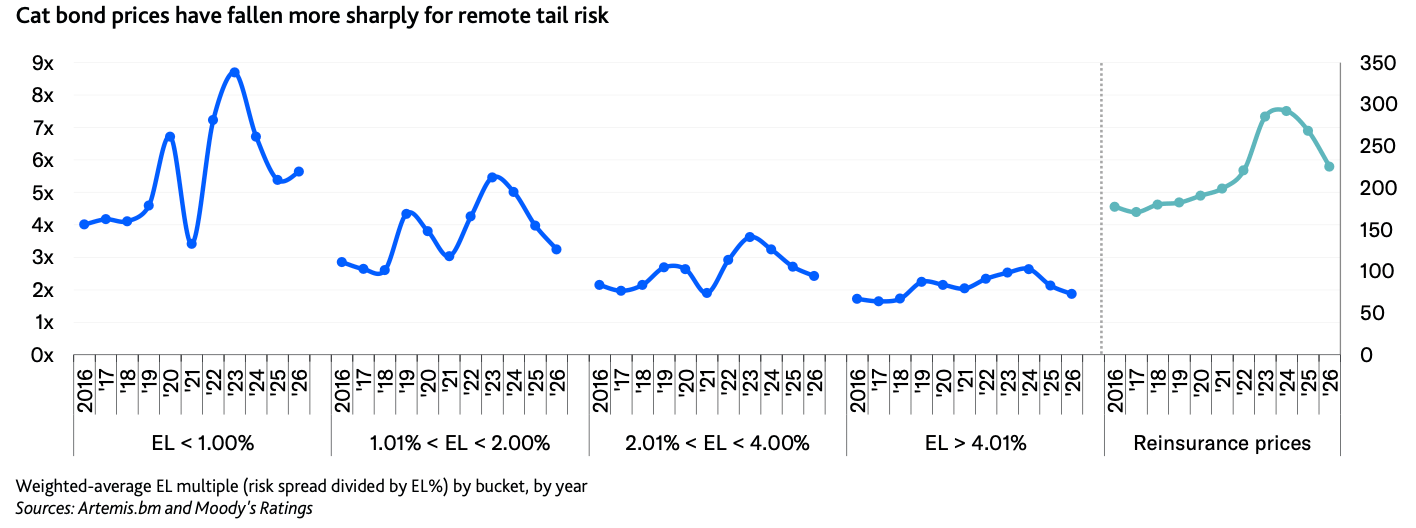
It’s important to note, that this also shows where demand is highest in the cat bond market, plus that fund managers have maintained discipline as pricing has fallen, absorbing more lower-risk tranches of notes while spreads still remained elevated and thus pressuring pricing more there.
How this dynamic moves over the next year will be telling, as we’d anticipate a levelling-off of spread multiples may now happen more quickly at the points on the risk curve where they declined fastest over the last couple of years. Appetites for higher-risk and return opportunities may remain more elevated for a time, until spread multiples there also become more compressed (if the trend persists).
Moody’s Ratings notes that, “While this has prompted a reassessment of relative value, the asset class continues to generate good returns for investors.”
While on the other side of the cat bond trade, “For sponsors, ILS retains clear appeal through pricing that is very competitive with traditional reinsurance, multi-year pricing certainty, diversified capital and collateralized protection.”
Finally, on pricing, Moody’s explains that, “The key question in the run up to the January 2027 reinsurance contract renewals is how much further pricing will adjust if losses stay benign. While the developing El Niño climate phenomenon is likely to suppress Atlantic hurricane activity, a single major landfall could reprice risk quickly.”
At the same time as the pricing dynamic has evolved and the economics of ILS has changed, alongside reinsurance, Moody’s also highlights some examples of how this has changed investor appetites as well.
Moody’s believes that risk transferability has broadened as investor risk appetite grows.
The rating agency said, “As ILS pricing moderates, investors are committing more capital to instruments with higher underlying risk of loss – aggregate covers, frequency protections and secondary perils such as wildfire, flood and severe convective storm – in search of stronger returns.”
Capital has become generally more available for these types of opportunities across both traditional reinsurance and the ILS market in the last twelve months.
Moody’s believes that as spreads compress to levels where the economic viability of remote risk cat bonds becomes less appealing to investors, the market is expanding its appetite.
“ILS investors demand a minimum absolute risk margin on any deal, largely independent of EL – to cover their cost of capital, minimum return hurdle, transaction/monitoring costs and an illiquidity premium. As prices for remote-risk low EL cat bonds drop, they reach a point where the economics no longer work for ILS investors, although they do for reinsurers, which have a different cost structure,” Moody’s states in its report.
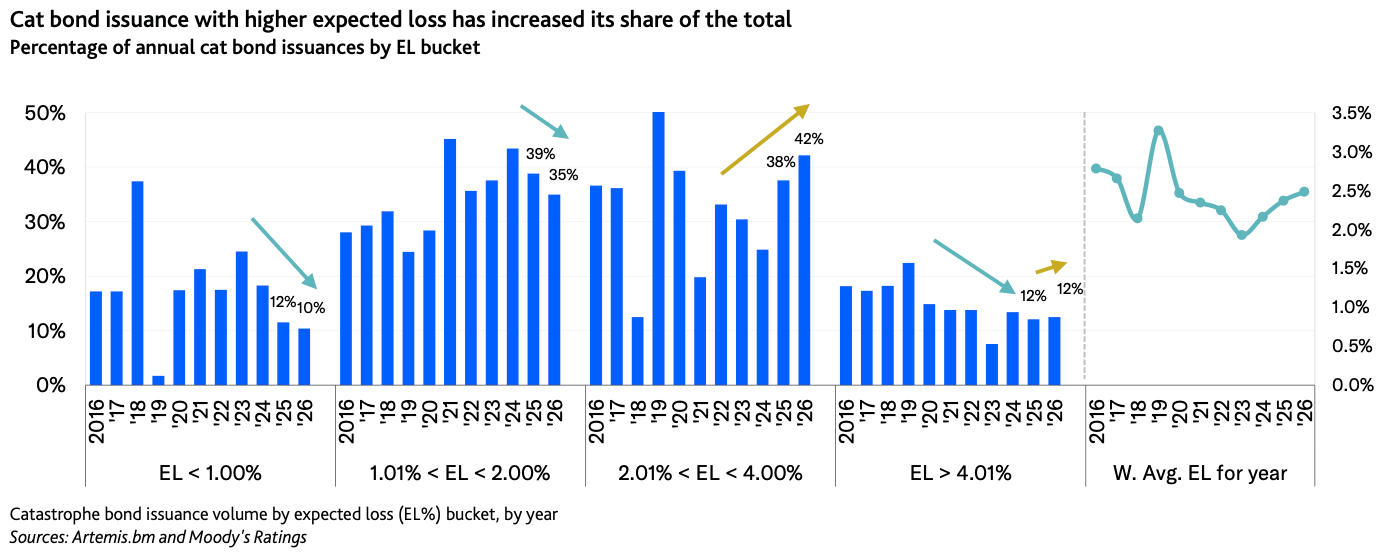
Adding that, “This results in lower cat bond issuance for remote risks. The weighted average expected loss across the market has risen as lower expected loss transactions shrink as a share of the total.”
This dynamic can be seen in the graphic below, taken from the Moody’s Ratings report and where the rating agency again utilises Artemis’ cat bond data.
Moody’s also points to increasing scope in the catastrophe bond market as a further signal of broadening investor appetites, with a number of deals seen over the last year that serve to expand the peril set of the cat bond market.
But this expansion of appetites does not come at any cost, as Moody’s also rightly notes that discipline remains firmly intact.
“Broader appetite is improving availability for historically hard-to-place risks. However, since moving up the risk curve raises exposure to modeling uncertainty and loss volatility, investors reman disciplined on trigger design and the aggregation of frequency losses. Multiple-peril aggregate bonds have been one of the main sources of loss to investors in past,” the rating agency said.
Overall, Moody’s explains that the ILS market is proving resilient against the backdrop of softening reinsurance pricing, shifting its risk appetite and expanding its horizons.
Increased flexibility of coverage in the catastrophe bond market can also attract new sponsors to the market, or old ones back again.
Going forwards though, as softening persists and competition rises, it is important investors and fund managers in cat bonds and ILS set their firm red lines to maintain the integrity of their strategies and portfolios.
 View all of our Artemis Live video interviews and subscribe to our podcast.
All of our Artemis Live insurance-linked securities (ILS), catastrophe bonds and reinsurance video content and video interviews can be accessed online.
Our Artemis Live podcast can be subscribed to using the typical podcast services providers, including Apple, Google, Spotify and more.