



The critical importance of underwriting discipline in reinsurance and insurance-linked securities (ILS) is laid bare in new analysis from PwC, with the company suggesting that remaining strict on terms, conditions and structures could be worth up to seven points of return on capital.
 To our knowledge, we haven’t seen anyone else try to quantify the impact of underwriting discipline on reinsurance underwriting outcomes and returns before, so this is a particularly helpful analysis at this stage of the softening cycle and with end of year renewal discussions starting around this time of the year.
PwC UK explained that, in time for the Monte Carlo Rendez-vous event, it has modelled an illustrative softening cycle through to 2030, with its work suggesting that the London market (which is its focus in the analysis) has moved into this phase from a stronger position than in the previous soft cycle.
Insurers and reinsurers are being supported by significant hard market pricing gains, higher investment returns and improved expense ratios.
But, PwC said that it anticipates meaningful further softening now, although it does not believe we will see a repeat of the depth of the previous soft market.
Those structural advantages gained through the hard market should not be taken for granted, PwC explained, as looking ahead returns generated will rely “not only on market conditions, but on how effectively firms translate their underwriting strategies into pricing, portfolio management, capital allocation and incentive structures as competitive pressures intensify.”
Andy Moore, PwC’s London Market Leader, commented, “The industry has spent years investing in underwriting controls, analytics and governance. The real test will come as competitive pressures continue to increase. Previous soft markets showed how easily commercial pressures can encourage firms to prioritise premium growth and market share over pricing discipline and long-term profitability. The businesses that outperform over the next cycle are likely to be those that ensure incentives, underwriting decisions and capital allocation remain focused on sustainable, risk-adjusted returns rather than volume alone.”
Moore further explained that PwC’s analysis involved modelling a range of scenarios for Lloyd’s and the London market out to 2030, assuming the same illustrative price movements but testing how underwriting discipline affects returns.
The conclusion is that “underwriting discipline matters” PwC said, with a scenario where discipline holds and firms maintain their return thresholds, constraining or redirecting capacity where pricing becomes inadequate, and the combined ratio remains at around 91% and return on capital (RoC) at around 13-14%.
But, a scenario where discipline slips, as competitive pressure increases, with premium retention, growth and market share increasingly prioritised over returns, results in the combined ratio coming out around 100% and lowers return on capital to around 7%.
PwC illustrates the different scenario regimes and how they drive changes in return on capital in the graphic below.
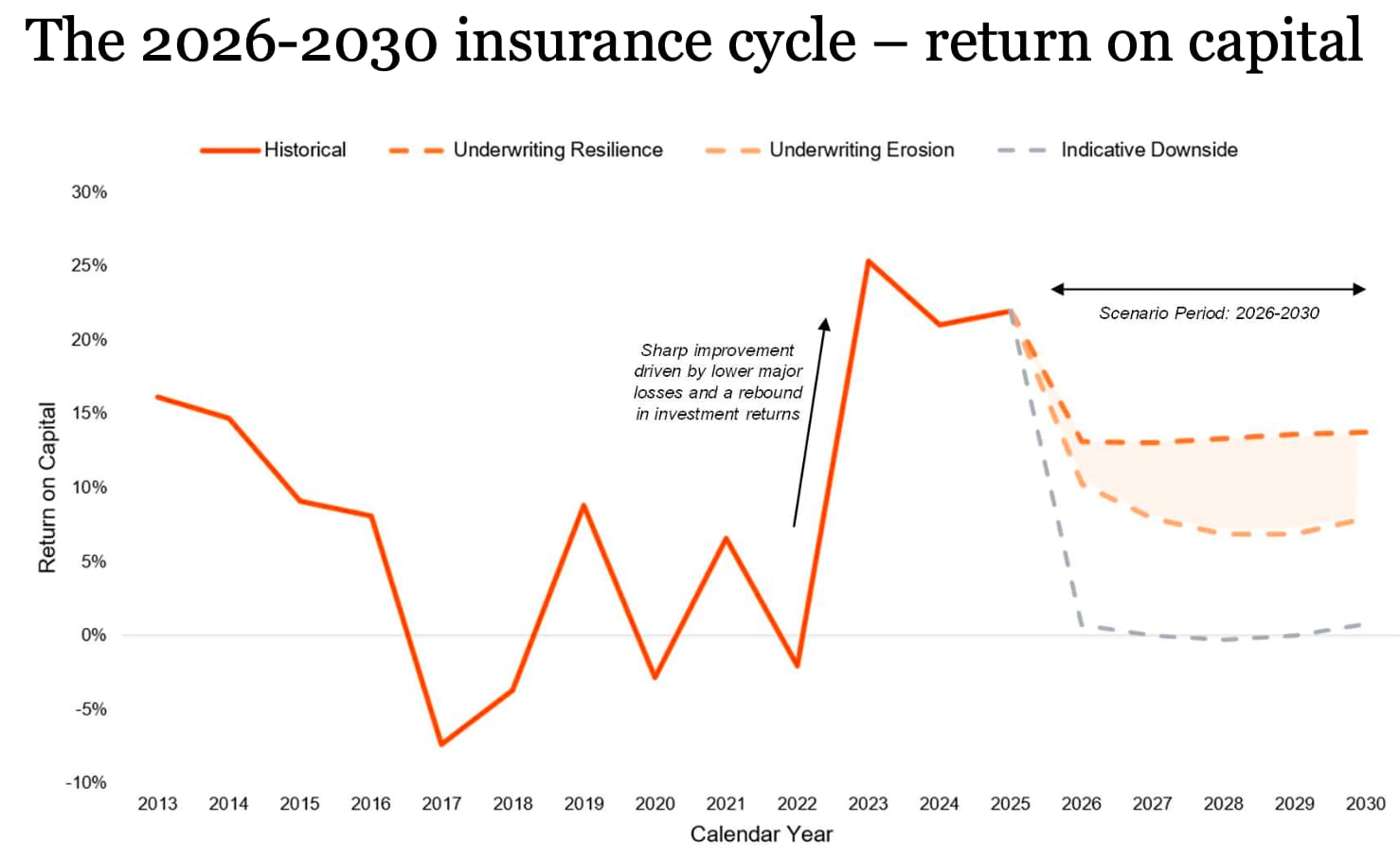
Which shows quite a difference in outcomes and this, while focused on London and Lloyd’s market players, is very instructive for the insurance-linked securities (ILS) market as well.
It clearly shows how structural discipline, on terms and conditions, as well as discipline in capital raising and management, matter significantly when it comes to return potential through a prolonged soft cycle of the reinsurance market.
PwC’s Moore explained, “The coming cycle is not simply a pricing challenge. The c.7 percentage-point difference in Return on Capital between our core scenarios highlights the value of maintaining underwriting discipline as the market softens.
“The challenge will be where firms choose to compete, when returns no longer justify deploying capacity and how quickly portfolios are reshaped in response.
“Outperformance is likely to depend on whether the discipline built during the hard market carries through into underwriting decisions, portfolio management, capital allocation and incentives – keeping the focus on sustainable, risk-adjusted returns rather than volume.”
PwC’s scenarios assume normalised loss activity and the company notes how major loss experience could materially change these return on capital outcomes.
PwC explained, “The indicative downside applies historically severe losses, taking RoC towards zero – more consistent with the heavier major loss years. This illustrates why the c.7-14% core range should not be interpreted as the full range of possible returns.”
But added that, “Underwriting performance can erode while returns remain sufficient to attract capital. At c.7% RoC, however, the premium for taking insurance risk is substantially reduced. With margins already compressed, heavy major loss experience could push RoC below the risk-free rate and towards zero, reducing the attractiveness of deploying capital and increasing pressure for the cycle to turn.”
This is why the current phase of the reinsurance market cycle is one to apply discipline in, as those that don’t could face dwindling returns if this stage of the cycle persists.
 View all of our Artemis Live video interviews and subscribe to our podcast.
All of our Artemis Live insurance-linked securities (ILS), catastrophe bonds and reinsurance video content and video interviews can be accessed online.
Our Artemis Live podcast can be subscribed to using the typical podcast services providers, including Apple, Google, Spotify and more.