



After a magnitude 7.3 earthquake struck just off the southern coast of Mexico on Friday, analysis suggests this event was a near-miss for attaching the parametric trigger of one tranche of notes from the country’s World Bank facilitated IBRD CAR Mexico 2024 catastrophe bond transaction.
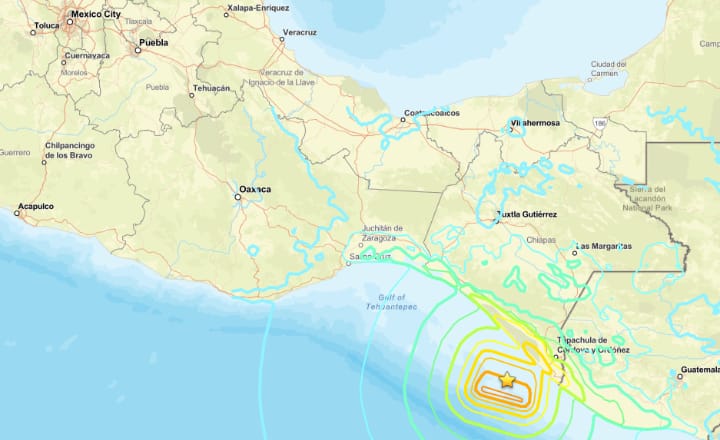 The magnitude 7.3 (M7.3) earthquake struck off the coast of Mexico west-south-west of Puerto Madero at 14:49 UTC (08:49 local time) on Friday July 17th 2026, causing widespread shaking across parts of southern Mexico and neighbouring Guatemala, while also being felt in El Salvador.
Mexico has a robust natural disaster risk transfer and insurance program in place, at the heart of which sits its World Bank supported catastrophe bond issuances, as well as its traditional parametric insurance program.
Which means the country is prudently protected against major disasters that could cause a drain on its finances, require rapid funding to support response and recovery, as well as to fund rebuilding from major events that occur.
Immediately after the earthquake on Friday, there were warnings of a potentially “hazardous” tsunami as well, although the waves eventually recorded were only around 0.3m high in Puerto Madero and Chiapas, Mexico, according to news reports.
Moderate intensity shaking was widely felt, with news footage showing buildings swaying and some minor damage being experienced.
However, importantly, local authorities and the Mexican government said that the quake had not caused any serious impacts or damages, or casualties, although evacuations were enforced and assessment of any damage to infrastructure has continued through the weekend.
Claudia Sheinbaum the President of Mexico, stated that while emergence protocols were activated after the earthquake on Friday and assessment of structures for potential impacts were ongoing, officials reported no significant damage in Chiapas and Tabasco states.
Following the occurrence of this earthquake off the coast of Mexico on Friday, members of the insurance-linked securities (ILS) investor community activated their own risk management protocols to analyse whether the event could potentially impact any of the outstanding Mexico cat bonds.
The Government of Mexico had secured $420 million of parametric disaster insurance protection against earthquakes and Atlantic hurricanes through the World Bank facilitated IBRD CAR Mexico 2024 catastrophe bond transaction, issued in early April 2024.
Two of the three tranches of notes in that cat bond issuance cover earthquake risks, while the third covered Atlantic hurricane events. If you recall, Mexico also followed up shortly after that issuance with another cat bond tranche issuance to cover Pacific named storm risks as well, the $175 million IBRD CAR Mexico 2024 (Pacific) cat bond.
The two earthquake exposed cat bond tranches, which are IBRD Capital-At-Risk notes 132 and 133, the Class A and B tranches of IBRD Mexico 2024, provide protection at different return periods.
The $225 million Class A tranche are the more remote in terms of risk with a modelled expected loss of just 0.9%, while the $70 million Class B tranche are higher risk and have a modelled expected loss of 5.84%.
It is the location and intensity of an earthquake event that determines whether a payout is due, with a typical parametric cat-in-a-box structure for the triggers of each tranche of notes.
There is also a stepped payout trigger arrangement, of 25%, 50%, 75% and 100% of principal for the earthquake risk cover, depending on the location and magnitude of any event that occurs.
These earthquake exposed IBRD World Bank cat bond tranches for Mexico came to market with a four year term, so are in-force and providing their disaster risk transfer protection until April 2028.
As a result, these tranches are available for any earthquake, such as Friday’s, that occurs within the structured parametric box design and layout.
Friday’s M7.3 earthquake occurred just off the south coast of Mexico towards the border with Guatemala, but analysis shows it occurred within one of the parametric trigger boxes (the trigger boxes cover areas off the coast in case of major earthquakes that occur offshore).
However, our own analysis and that of two ILS investment managers that we spoke with, suggests that the box in question that the quake appears to have occurred in would require an earthquake to be M7.4 or greater in intensity for any payout to Mexico to come due from Friday’s quake.
It is the $70 million Class B riskier tranche of notes that were a near-miss, requiring an M7.4 or greater quake in that location for a 25% of principal payout to be activated, the analysis suggests. For the Class A notes, a much more intense M7.9 earthquake would have been required.
Which means that, if the analysis is correct (it’s always a little uncertain as information available to us is limited), in this case no payout will be due to Mexico unless the USGS were to revise up the intensity of Friday’s earthquake to M7.4, which could put the Class B cat bond notes on-risk.
However, we understand upwards revisions in earthquake intensity are not typically seen and this is also what the ILS specialist investors we spoke with have concluded.
Friday’s M7.3 earthquake was therefore only M0.1 away from triggering a 25% payout for the $70 million IBRD CAR 133 Class B notes of Mexico’s catastrophe bond transaction, it appears.
It’s important to note, that it may still be too early to give a definitive all-clear, as the terms of the cat bond may allow for a period of time for any intensity revisions to be made. At this stage there hasn’t been any revision made to the magnitude of Friday’s quake either way by the USGS.
Given the reporting from Mexico and the statements from its own local officials and national government all suggest damage was relatively minor after this offshore earthquake, a payout was perhaps not warranted in this particular case.
However, it does present another good reminder that parametric trigger design is critical, in calibrating attachment points carefully to closely approximate the potential damage and financial impact from a natural disaster event, so as to minimise basis risk in the transaction both ways (for sponsor and investors).
At this stage it’s not clear whether any of Mexico’s other parametric disaster insurance arrangements were activated by Friday’s earthquake.
Recall that Mexico’s Government recently finalised its main insurance protection for natural disasters and severe weather events for the coming year, doubling the size of its parametric catastrophe insurance arrangement to around US $575 million for 2026 into 2027, which came into force in early June.
You can read all about the $420 million IBRD CAR Mexico 2024 cat bond that provides Atlantic hurricane and earthquake protection and the $175 million IBRD CAR Mexico 2024 (Pacific) named storm catastrophe bond, as well as more than 1,250 other cat bond transactions in the extensive Artemis Deal Directory.
 View all of our Artemis Live video interviews and subscribe to our podcast.
All of our Artemis Live insurance-linked securities (ILS), catastrophe bonds and reinsurance video content and video interviews can be accessed online.
Our Artemis Live podcast can be subscribed to using the typical podcast services providers, including Apple, Google, Spotify and more.