




Third-party capital in reinsurance, deployed through alternative capital vehicles, catastrophe bonds and insurance-linked securities, is projected to grow roughly 6% over the course of this year, to end 2026 around a record $130 billion level, according to the latest data from AM Best and Guy Carpenter.
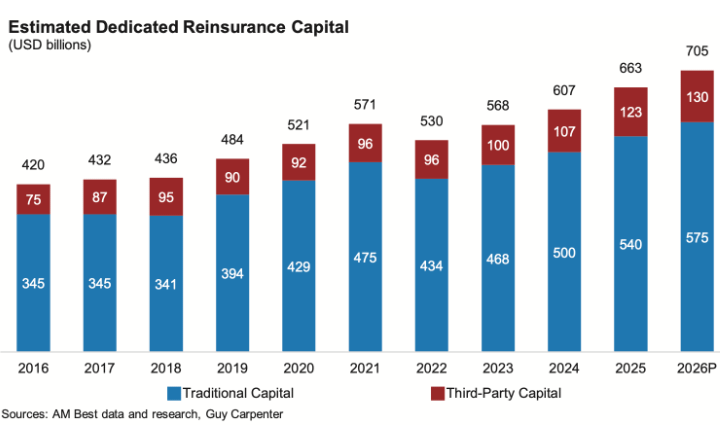 The growth rate would have been higher at more than 8%, but rating agency AM Best and reinsurance broker Guy Carpenter have now raised their end of 2025 figure for third-party reinsurance capital, from the previous estimate of $120 billion to now $123 billion.
The pair had previously forecast third-party capital to have grown over 12% during the course of 2025 to a record $120 billion, but that has now been updated to $123 billion at the end of last year.
Which means that 2025 actually saw third-party capital across cat bonds, ILS and other structures such as reinsurance sidecars grow by a massive 15%.
While third-party capital is now projected to grow by just under 6% in calendar year 2026, AM Best and Guy Carpenter project slightly faster growth for traditional reinsurance capital, by almost 6.5%.
The pair see traditional reinsurance capital growing from $540 billion at the end of 2025, to a new high of $575 billion by the end of the year.
Which puts total global reinsurance capital at $705 billion, projected for the end of 2026, up 6.3% from $663 billion at the end of last year.
AM Best noted that, with the new record-highs in reinsurance capital expected, the industry will enter 2027 from a position of strength.
“Reinsurers have benefited from several years of improved underwriting conditions, elevated investment yields, disciplined capital deployment, and generally favorable catastrophe experience relative to pricing assumptions. As a result, dedicated reinsurance capital is expected to reach another record level, extending a period of capital accumulation that has few parallels in recent market history,” the rating agency explained this morning.
Capital levels continue to accumulate, both in traditional reinsurance and across the insurance-linked securities (ILS) market.
One challenge that will be faced, is that the industry is awash in capital but areas of the market to put it profitably to work are shrinking with the softening of reinsurance pricing.
AM Best commented that, “Dedicated reinsurance capital has continued to increase through retained earnings growth derived from underwriting profit coupled with favorable investment returns, and growth in third-party capital participation.This capital growth has occurred largely within existing market participants. Unlike prior hard markets, the industry has not experienced a significant influx of newly formed reinsurers seeking market share by underpricing business. This distinction has helped moderate competitive dynamics, as organic capital growth tends to enter the market more gradually than capital raised by new entrants and be deployed across more diverse underwriting markets.”
Adding that, despite the sector having more optionality for deployment than before, “As capital continues to accumulate, management teams may increasingly seek opportunities to deploy excess capacity through acquisitions, business expansion, or simply increasing shareholder distributions and returning capital accumulated during the hard market.”
AM Best added, “These alternatives could ultimately support pricing discipline by reducing pressure to deploy capital solely within the property catastrophe reinsurance market. However, if competitive forces begin to outweigh these alternatives and pricing deteriorates materially, the industry could find itself, once again, with rates below adequate risk-adjusted levels.”
AM Best fears that the reinsurance market may not be able to resist the temptations that excess capital brings. We’ll bring you more on that in a follow-up article later this morning.
 View all of our Artemis Live video interviews and subscribe to our podcast.
All of our Artemis Live insurance-linked securities (ILS), catastrophe bonds and reinsurance video content and video interviews can be accessed online.
Our Artemis Live podcast can be subscribed to using the typical podcast services providers, including Apple, Google, Spotify and more.