




The Colorado State University (CSU) tropical meteorology team has issued the first update to its seasonal forecast for the 2026 Atlantic hurricane season, now calling for slightly less activity in terms of named storms and hurricanes and giving reduced probabilities of landfall in key regions, citing the increased likelihood of a moderate to strong El Niño as a primary factor.
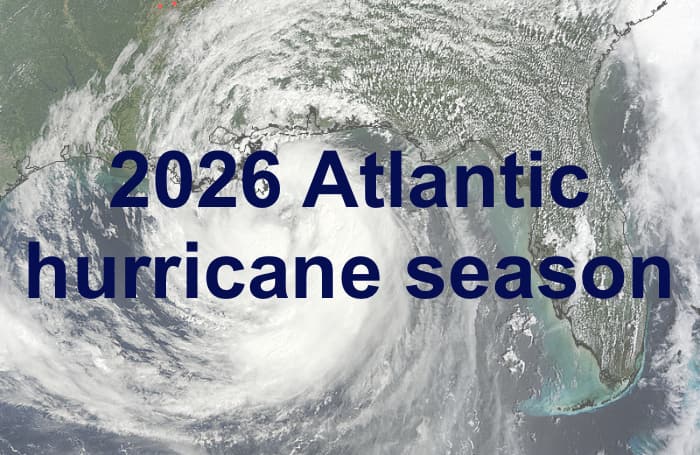 At its June forecast update, the Colorado State University (CSU) tropical meteorology team has updated the numbers to call for 11 named tropical storms, 5 hurricanes and 2 major hurricanes this 2026 season.
That’s a reduction from the 13 named storms, 6 hurricanes and 2 major hurricanes it had called for back in April, when its first seasonal forecast was made.
In addition, the team’s forecast for Accumulated Cyclone Energy (ACE) for the 2026 hurricane season had been lowered to an Index value of 70 in the June update, from 90 at the April forecast.
The CSU team cites, “The increased likelihood of a moderate to strong El Niño as a primary factor for the prediction of 11 named storms (e.g., tropical storms and hurricanes), of which they anticipate five to become hurricanes and two to become major hurricanes (Category 3+ on the Saffir-Simpson Hurricane Wind Scale).
“These numbers are below the long-term seasonal average of 14, seven and three, respectively. For reference, the April forecast called for 13, six and two, respectively.”
In addition, the forecasting team explained, “We predict Atlantic basin Accumulated Cyclone Energy (ACE) and Net Tropical Cyclone (NTC) activity in 2026 to be approximately 55–60 percent of their long-term averages. We have reduced the forecast numbers from our April outlook due to increased confidence in a moderate to strong El Niño for the peak of the Atlantic hurricane season.”
A moderate to strong El Nino is now anticipated by the peak of the 2026 Atlantic hurricane season, from August to October, they further explained.
“The tropical Pacific is currently characterized by warm ENSO neutral conditions, but all signs point towards a robust El Niño in the next couple of months. Sea surface temperatures in the western tropical Atlantic are near average, while they are below average in the eastern and central tropical Atlantic. We currently anticipate that the moderate to strong El Niño will dominate the tropical circulation during the peak of the 2026 Atlantic hurricane season, likely driving well above-normal levels of vertical wind shear across the tropical Atlantic and Caribbean,” the forecast further states.
Sea-surface temperatures present “mixed signals” though, with the eastern subtropical Atlantic seen as relatively warm, which can favor above-normal Atlantic hurricane activity, but at the same time the eastern and central tropical Atlantic have relatively cool waters, which can favor below-normal hurricane activity.
This is why it’s been highlighted for this season that there will remain areas where tropical activity could emerge, with the right conditions and some have highlighted the US eastern seaboard and Gulf as areas to watch.
That said, El Nino and the expected higher levels of wind shear could remain the key drivers throughout the season, meaning conditions where tropical storm formation becomes more conducive could be more short-lived, but this does not count out the fact a storm could spin up at short notice if conditions were more favourable at that time.
“Given the marginal signals in the Atlantic and the increased likelihood for a moderate to strong El Niño, the CSU forecast team is now more confident in its prediction of a below-normal 2026 season,” the forecasters said today.
The CSU team always gives helpful landfall probabilities for a Category 3 or stronger hurricane hitting the United States coastline in certain areas in its forecasts.
These metrics have all been reduced with this June update:
- 24% for the entire US coastline, down from 32% in the April forecast (below the 1880 to 2020 average of 43%).
- 11% for the U.S. East Coast including Peninsula Florida, down from 15% in the April forecast (south and east of Cedar Key, Florida) (the average is 21%).
- 14% for the Gulf Coast from the Florida Panhandle, down from 20% in the April forecast (west and north of Cedar Key, Florida) westward to Brownsville (the average is 27%).
The probability for a major hurricane tracking through the Caribbean is now given as 26%, down from 35% at the April forecast and so further below the average of 47%.
When including all of the seasonal hurricane forecasts we’ve seen so far and this latest update from CSU, the average across them remains for 12 named storms, 5 hurricanes and 2 major hurricanes during the 2026 season in the Atlantic basin, which is below the longer-term and recent historical seasonal averages. The average for ACE for the season has now dropped further to 73.
As we always have to say, just one major storm that makes landfall in a region with high economic and insured values can drive significant impacts to the insurance, reinsurance, catastrophe bond and insurance-linked securities (ILS) markets.
A forecast for lower storm numbers does not mean a greatly reduced chance of damaging hurricane events occurring.
Read some articles on the value of seasonal hurricane forecasts:
– Cat bond portfolio construction more important than seasonal hurricane forecasts: Man Group.
– ILS investment outcomes about more than just hurricane season forecasts: Gibson, Schroders Capital.
– Adjusting ILS exposure for July hurricane forecast can deliver excess returns: Euler, TSR study.
 View all of our Artemis Live video interviews and subscribe to our podcast.
All of our Artemis Live insurance-linked securities (ILS), catastrophe bonds and reinsurance video content and video interviews can be accessed online.
Our Artemis Live podcast can be subscribed to using the typical podcast services providers, including Apple, Google, Spotify and more.