




Catastrophe bond insurance risk spreads declined by 9.5% during the month of September 2026 as wind seasonality took hold, but with treasury yields having risen the increase to the risk free rate of return on collateral served to offset the impact to the cat bond market coupon available to investors, the latest data on cat bond yields from Plenum Investments shows.
Insurance risk spreads and coupon yields in the catastrophe bond market have been on the decline through the hurricane season peak, while at the same time the softening of reinsurance prices, and resulting lower cat bond spreads, are also having an effect.
As a result, by September 25th, the overall coupon yield of the catastrophe bond market had fallen to 8.74%, which is down from the August 28th figure of 8.87%.
Insurance risk spreads, so the catastrophe risk-linked return component of catastrophe bonds is where the decline emanates, as season pricing effects reduce this figure as would be anticipated for this time of year, while the lower spreads at issuance of recent new cat bonds also filters through into the market’s return.
Cat bond insurance risk spreads ended September 25th at 4.57%, down 9.5% from the August 28th figure of 5.05%.
But, at the same time, with treasury yields rising and this being the collateral of choice in the catastrophe bond market, this risk-free component of investors returns has risen as well.
The collateral yield across the catastrophe bond market rose from 3.81% in late August to a new higher level of 4.17% as of September 25th. Notably, that is now the highest collateral yield on cat bonds in more than one year and while not guaranteed to be permanent, given the current state of the US treasury bond market there is every chance this component remains higher to continue to offset declining risk spreads to a degree.
Plenum Investments commented on the end of September numbers, “The spread tightening continues despite the very mild hurricane activity in the Atlantic. Average market spreads declined by a further 9.5% month-on-month in September.
“As expected, September therefore saw the strongest spread tightening over the summer months. From October onwards, the pace of spread tightening is expected to slow further due to seasonal effects.”
Click the chart below to analyse the interactive data:
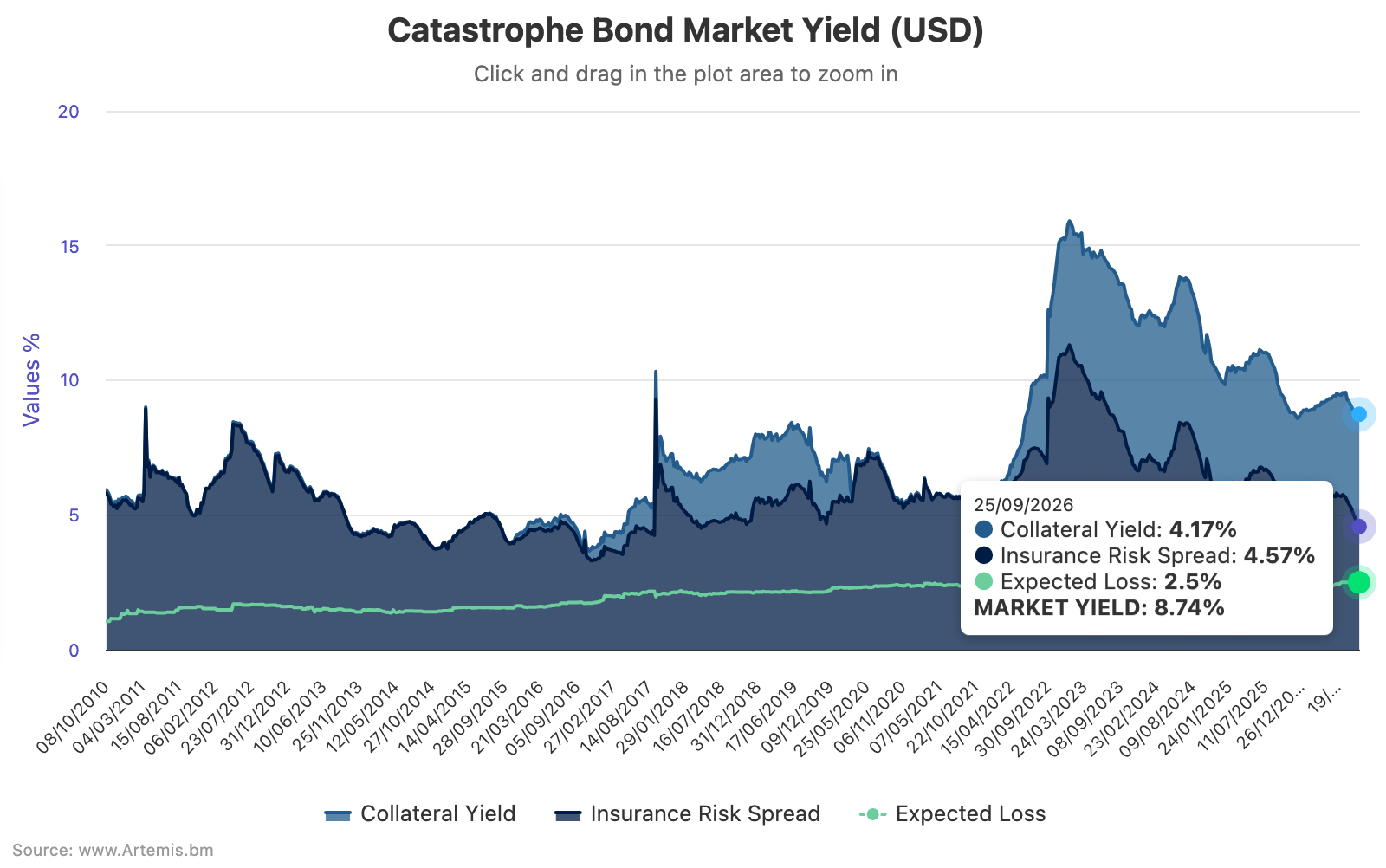
It is, of course, important to look at where risk spreads and the total coupon yield of the catastrophe bond market stand compared to the historical record and previous soft market phases of the reinsurance cycle.
First, insurance risk spreads across the catastrophe bond market of 4.57%, where they stood on September 25th 2026, are now at the lowest level for that data point since around April 2018.
At that level risk spreads are below the average seen in the history of Plenum Investment’s data, which began in 2010. But, they remain higher than some of the lows seen during trough of the last soft reinsurance market, when cat bond risk spreads had fallen to as low as 3.3% in 2016.
It’s important to remember that back then, when insurance risk spread of the catastrophe bond market bottomed out in November 2016, the risk-free return on collateral was around 0.5%, so significantly lower than we see today.
As a result, at the time when risk spreads bottomed out in 2016, the total yield of the catastrophe bond market, or the coupon available to cat bond investors, fell to as low as around 3.70%.
Today, that stands at the aforementioned 8.74% level of cat bond market total return. While cat bond risk spreads are likely to continue to decline until the peak hurricane season passes, absent any impactful event, the pace is expected to slow and at this stage it feels unlikely to result in a retrenchment to 2016 levels.
Of course, we have to also mention terms and conditions, as back in 2016 when risk spreads bottomed out the soft market terms seen across reinsurance meant perhaps significantly more risk was being taken on for every basis point of potential return.
The expected loss of the cat bond market was meaningfully lower back then, but we’ve never been completely convinced that expected loss over-time captures all of the ways exposure can be stretched, or creep into portfolios, due to the relaxation of reinsurance contract terms.
Remember also that the catastrophe risk models used over the last decade have changed meaningfully as well, so it does make comparing expected loss metrics fraught with difficulty.
We can look at the catastrophe bond market’s return over expected loss though, so the expected excess return of sorts.
Today, with the cat bond market’s expected loss standing at 2.50%, notably the highest in the record of this data although only just above levels seen in 2021, the yield above expected loss of the cat bond market stands at 6.24% as of September 25th 2026, a decline from the 6.37% level seen as of August 28th.
But, back in the depths of the 2016 soft reinsurance market, even with the expected loss being lower at that time, the cat bond market yield over expected loss fell to less than 2%.
As we explained before, through year’s 2020 and 2021 the average catastrophe bond market yield above expected loss was just 3.70% and dipped as low as sub-3% over that period and it had previously fallen below 2% in 2016.
So the catastrophe bond market yield over expected loss remains more than three times higher than it fell to in the last soft reinsurance market and more than double the levels seen as recently as 2021.
Which shows why the market remains deemed attractive to investors, even without considering the evident diversification and decorrelation benefits catastrophe bond allocations have for their portfolios.
Analyse catastrophe bond market yields over time using this chart.
 View all of our Artemis Live video interviews and subscribe to our podcast.
All of our Artemis Live insurance-linked securities (ILS), catastrophe bonds and reinsurance video content and video interviews can be accessed online.
Our Artemis Live podcast can be subscribed to using the typical podcast services providers, including Apple, Google, Spotify and more.