



The global data centre build-out is creating unprecedented risk concentrations in natural disaster zones, and pushing traditional insurance capacity to its limits. Howden sees this as a prime opportunity for the capital markets, as catastrophe peak risk remains the foundations of the insurance-linked securities (ILS) asset class.
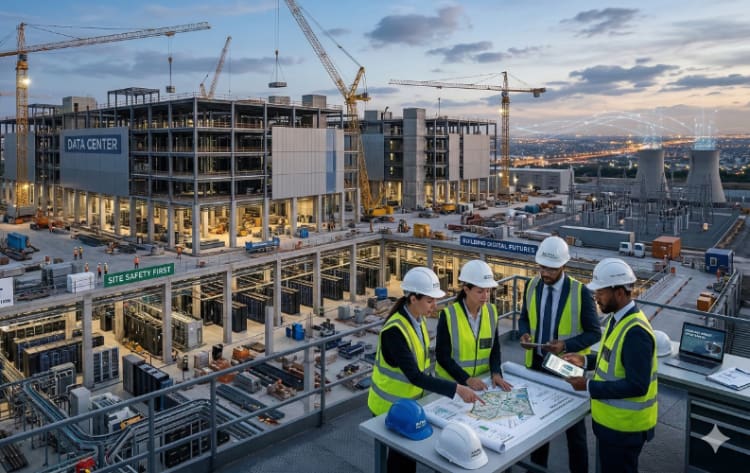 According to Howden’s new report, in the US, a significant number of major data centre hubs are located in areas highly exposed to extreme weather, while on a global scale, more digital infrastructure is being developed in areas affected by armed conflict.
“In the US, a significant number of major data centre hubs are located in areas highly exposed to extreme weather, while globally more digital infrastructure is being developed in areas affected by armed conflict. In addition, the fast pace of development is contributing to a sharp rise in legal disputes globally,” Howden said.
Importantly, the broker outlines that while 155 US locations hosting data centres have experienced at least one severe hailstorm or tornado over the past 10 years, just 20 of those locations account for around 80% of the data-centre square footage impacted.
Howden said: “The massive scale of financial exposures demands resilient construction and design to make efficient use of the limited insurance capital available as the market scales.
“US data centres that suffered at least one severe hailstorm or tornado in the past ten years generate roughly $16 billion in annual revenue. This is roughly the size of the 29-year-old global cyber insurance market and significantly larger than global data centre premiums.”
Howden also outlined that hyperscale campuses require large, cost-effective plots with access to power and fibre, criteria that steers development towards inland regions, many of which happen to be exposed to extreme weather, including flooding, extreme heat, severe storms, lightning and wildfires.
The broker explained that the issue is compounded by the clustering of data centres in the current phase of construction, which is occurring in natural catastrophe-exposed states such as Texas.
“The overriding message for buyers and the market is constructive: exposure to extreme weather appears more geographically concentrated than the consensus view suggests. The concentration of value at individual sites nevertheless creates aggregation risk and demand for very high limits, given the full construction cost of a single site can reach $20 billion (up to double once all the technology is installed),” Howden’s report reads.
“This demand is both an opportunity and a challenge. Natural catastrophe risk is well understood and, unlike some data centre exposures, supported by decades of catastrophe modelling data. These are also high-value but high-quality risks, built to a high standard of physical resilience. The challenge is that values are now concentrated at single locations and clustered within a handful of high-hazard regions, creating exposures beyond what the traditional market can absorb efficiently alone.”
Turning attention to the capital markets, Howden said: “This is precisely the type of risk the capital markets are structured to take on, with catastrophe peak risk being the original asset class for insurance-linked securities (ILS).
“Meeting increased demand will depend on drawing in catastrophe-oriented capital – including ILS, asset managers, life insurers and sovereign wealth funds – to complement traditional reinsurance and support sustainable growth. However, that capital is most readily unlocked when risk can be aggregated into portfolios offering sufficiently large premium volumes and the risk diversification that investors need to meet return thresholds. This will require further growth and maturation of the data centre segment.”
This echoes a recent report from Swiss Re Institute, which indicated that AI data centres and renewable energy infrastructure alone could generate around $200 billion in insurance premiums between 2026 and 2030, who also emphasised how this opportunity creates a clear role for alternative reinsurance capital, particularly in catastrophe bonds and sidecars.
Stuart Adam, Head of Natural Resources, Howden US, commented: “Being able to gauge exposure to severe weather means being able to make smarter decisions around site selection, risk mitigation and how insurance capital is deployed. Despite exposure to extreme weather, these ‘nat-cat’ prone areas are often chosen for access to power and space. This need for power is also seeing data centre developers and owners across the US increasingly becoming power plant owners and managers in their own right. That creates a litany of new exposures that developers, investors and insurers need to understand long before breaking ground.”
Edward Howland Jackson, Chief Commercial Officer, Global Specialty, Howden, said: “The AI boom is fuelling huge investment in data centres globally but as our analysis shows, the risks associated with this expansion are wide-ranging and increasingly complex.
“For data centre operators, developers and investors, understanding where these risks are concentrated is critical. The opportunity for the insurance market is not simply to provide more capacity, but to use data, specialist advice and risk transfer to help clients identify these exposures early and build greater resilience as the sector expands.”
Concluding: “Navigating this increasingly complex risk landscape requires specialist risk expertise and deep insurance market insight. Howden combines these capabilities with proprietary analysis to help clients understand and mitigate their exposures and deliver differentiated risk transfer solutions.”
Read other Artemis articles about the data centre risk transfer opportunity for ILS here.
 View all of our Artemis Live video interviews and subscribe to our podcast.
All of our Artemis Live insurance-linked securities (ILS), catastrophe bonds and reinsurance video content and video interviews can be accessed online.
Our Artemis Live podcast can be subscribed to using the typical podcast services providers, including Apple, Google, Spotify and more.