



Retrocession is back in fashion as market conditions evolve across reinsurance and rating agency S&P believes retro buying is set for a comeback, as reinsurers recognise favourable pricing and conditions for protection, while looking to manage their catastrophe limits in a softening market.
S&P Global Ratings highlights that “catastrophe risk appetite could become more subdued through 2027 due to softening reinsurance pricing,” but said that natural catastrophe risk in the sector remains under control, as reinsurers adopt a measured approach to growing in property risks.
“Although we expect pricing for this business to continue softening, we project the industry’s benchmark group will retain capital levels commensurate with our ratings on them,” the rating agency explained.
In fact, S&P believes the sector’s capitalisation “is likely to withstand severe industry-wide losses exceeding $300 billion without falling below key confidence levels,” which reflects just how well-capitalised the reinsurance industry remains today and the fact it will likely take meaningful losses to derail the current market trajectory.
Further underscoring this, S&P stated in a report released just prior to the Monte Carlo RVS, “We expect 19 of the 20 reinsurers in our benchmark group to maintain their capital adequacy and earnings scores even in the event of a 1-in-250-year aggregate natural catastrophe loss scenario.”
“Ultimately, performance will depend on underwriting discipline and prudent risk appetite frameworks,” said S&P Global Ratings credit analyst Sachin Bhojani in a new report. “Reinsurers that successfully balance growth ambitions with risk mitigation will be well positioned to protect capital strength and navigate the next phase of the reinsurance cycle.”
But, despite this capital strength across the reinsurance sector, S&P also notes that reinsurers recognise the opportunity to benefit from softening market conditions to further build their protection through retrocession purchases.
S&P said that “retrocession is set for a comeback as market conditions evolve.”
As of January 1st 2026, S&P’s benchmark reinsurance group on average ceded roughly 50% of their exposure to a 1-in-250 year event.
The approach to retrocession varies though, with some buying much more than others and the largest group 1 players opting to retain more risk and cede less to retrocession.
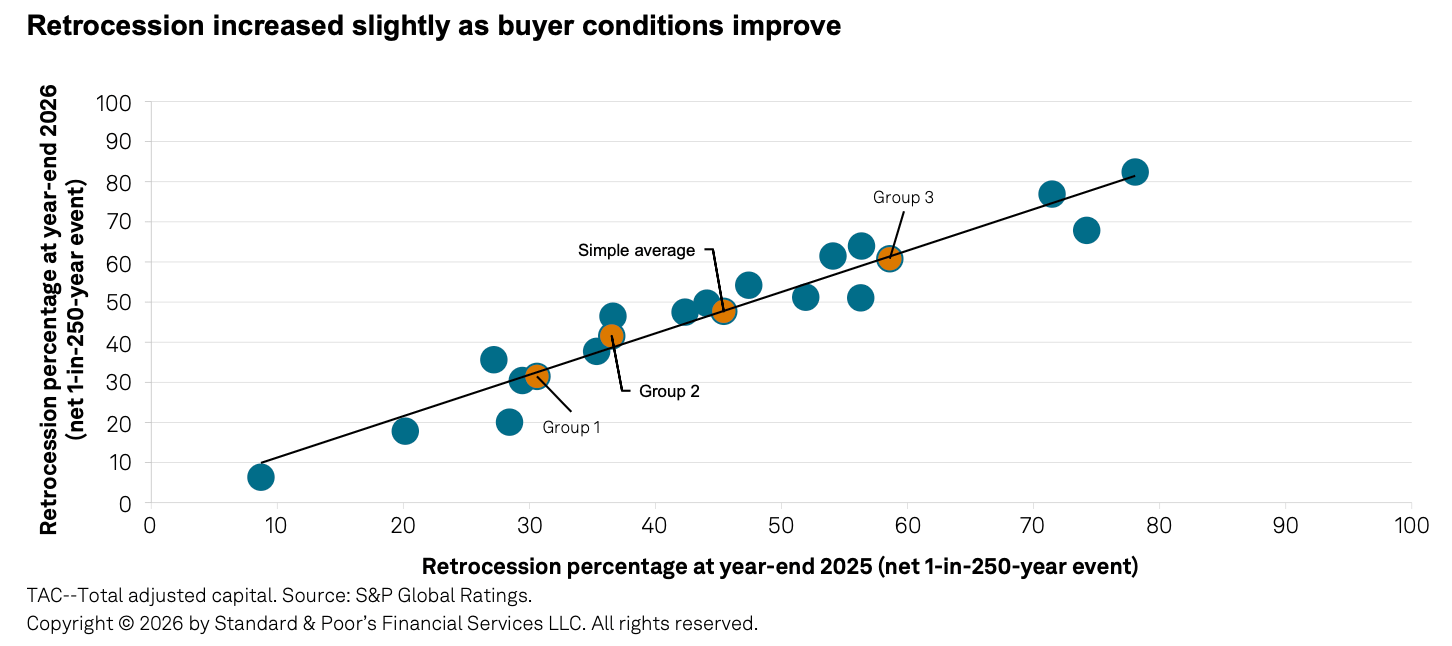
You can see the chart from a year earlier in our article from this time last year.
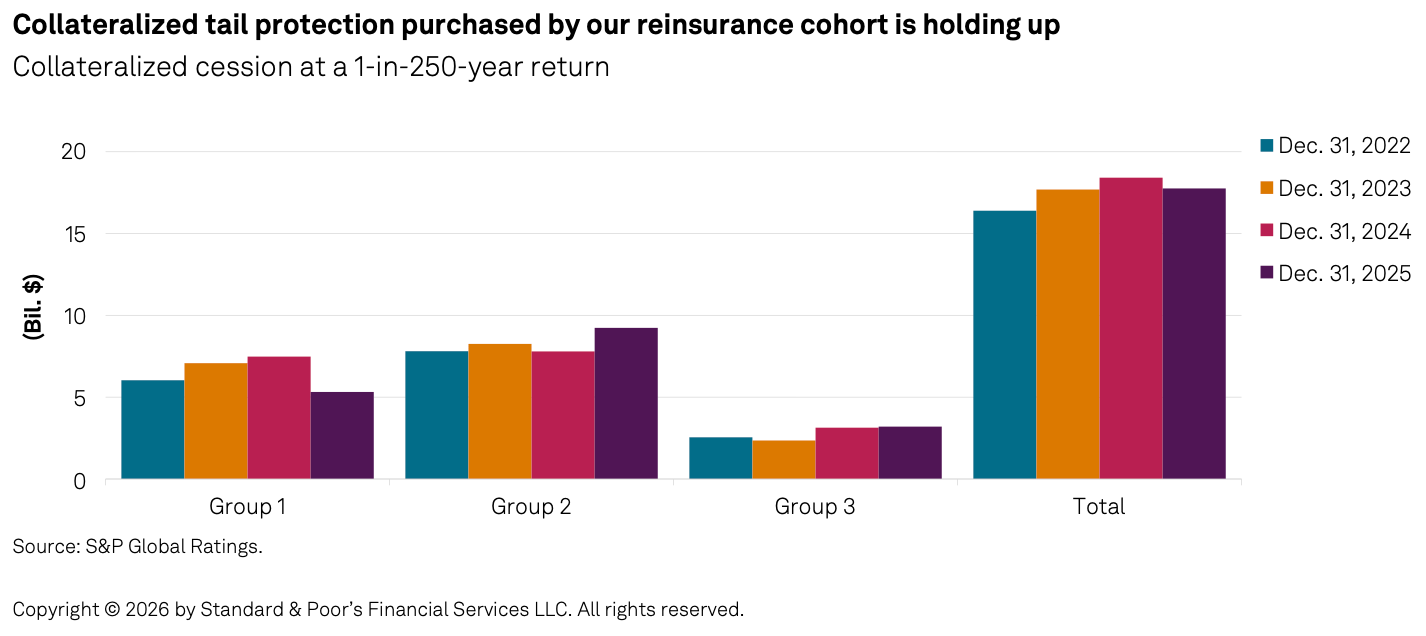
Collateralized sources of retrocession capacity remains a vital form of protection for the major reinsurance companies of the world.
S&P noted that, “Alternative capital remains a significant source of capacity, reinsurers have, on an absolute basis, kept collateralized tail protection largely stable, in line with prior year levels.”
Group 1 reinsurers (Hannover Re, Lloyd’s, Munich Re, SCOR and Swiss Re) in the S&P cohort have reduced their use of collateralized tail retro protection in the last year, which aligns with the fact a number have shrunk down their reinsurance sidecars and other structures in order to retain more catastrophe risk, as they deem returns still more than adequate despite market softening.
But, Group 2 reinsurers, Arch Capital, Everest Group, Fairfax Financial and RenaissanceRe, have increased their use of collateralized tail protection. It’s worth remembering Arch, Everest and RenRe are all managing meaningful amounts of third-party capital in partnership structures backed by third-party investors, which may be part of the driver here, with these firms having optionality at their disposal.
Group 3 reinsurers, the slightly smaller but still largely global players, also increased their usage of collateralized tail protection slightly.
So it is the decline in collateralized retro usage by the largest reinsurance groups in the world that has kept this metric roughly flat, on average.
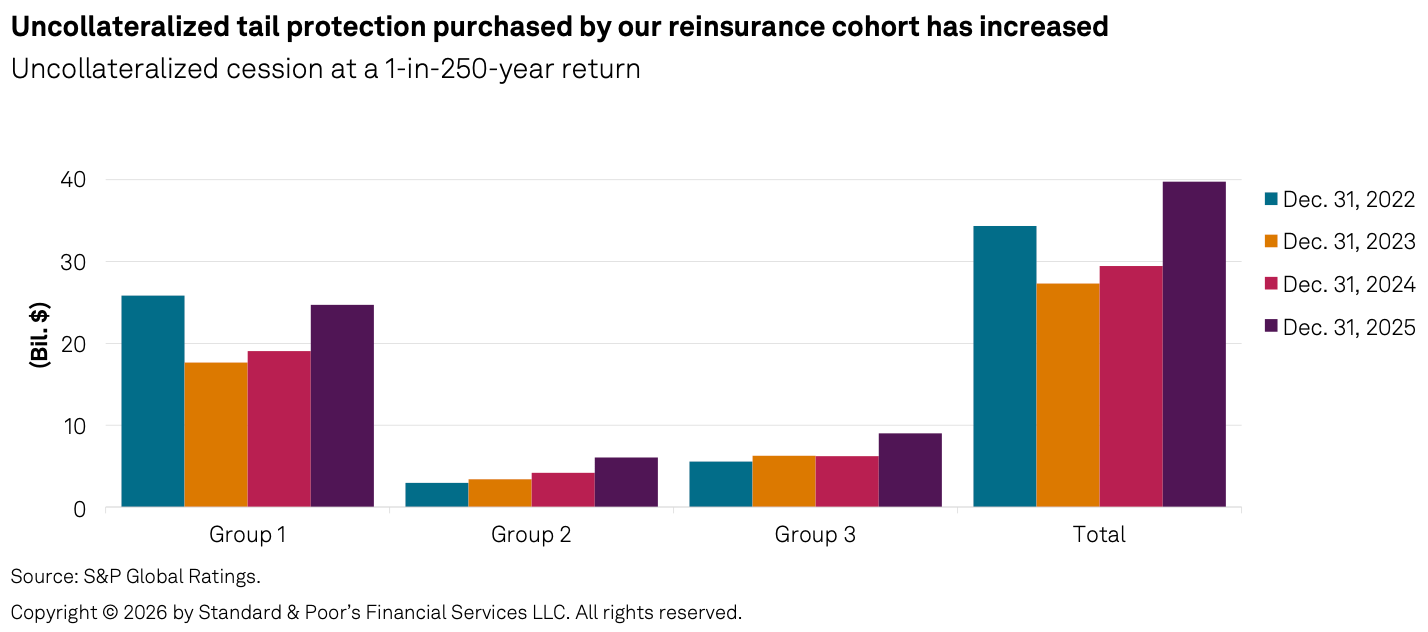
Interestingly though, S&P’s data suggests that traditional retrocession usage, so uncollateralized tail protection, is up across the group. Here, it’s worth also considering that some insurance-linked securities (ILS) managers have access to rated underwriting structures that enable them to put up balance-sheet capacity with the collateral sitting further back in the market infrastructure supporting this, so there may be some greater use of such fronted retro arrangements showing up here.
S&P said, “An increase in the amount of traditional retrocession reflects improved market conditions in the traditional retrocession market; specifically, softer pricing and increased capacity have enhanced the attractiveness of conventional retrocession covers, leading to an uptick in traditional usage across the sector.”
S&P’s view of prospects for global reinsurance players is that discipline is now key as the evolution of the market continues in 2026 and into 2027.
How disciplined they are will shape their prospects going forwards, meaning their performance will “increasingly depend on underwriting discipline, portfolio management, and prudent risk appetite frameworks,” S&P explained.
“Reinsurers that successfully balance growth ambitions and risk mitigation will be well positioned to preserve earnings, protect capital strength, and navigate the next phase of the reinsurance cycle,” the rating agency concluded.
 View all of our Artemis Live video interviews and subscribe to our podcast.
All of our Artemis Live insurance-linked securities (ILS), catastrophe bonds and reinsurance video content and video interviews can be accessed online.
Our Artemis Live podcast can be subscribed to using the typical podcast services providers, including Apple, Google, Spotify and more.