



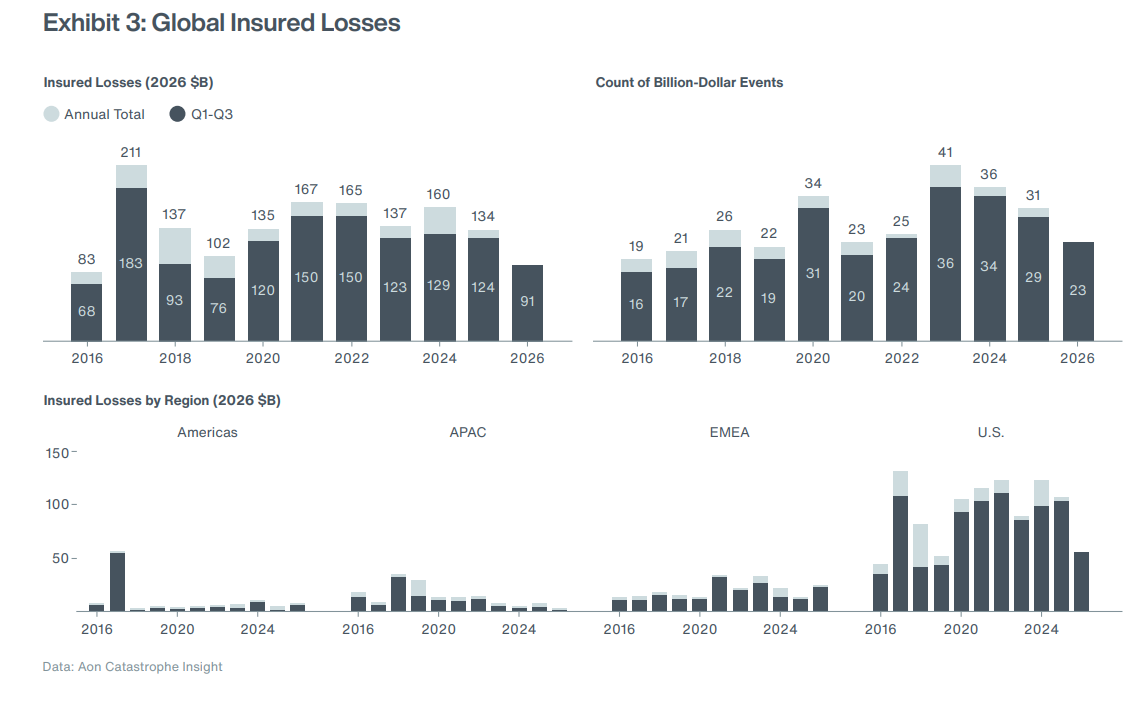
According to insurance and reinsurance broker Aon, global insured losses from natural catastrophe events reached $91 billion during the first nine-months of 2026, the lowest for the period since 2019’s $76 billion, and remained well below the $135 billion average of the past five years, but slightly above the 21st-century average of $88 billion.
 The broker’s latest Global Catastrophe Recap revealed that natural catastrophe losses paid by the global insurance and reinsurance industry in the third-quarter of 2026 reached $29 billion, which Aon said was 31% below the 21st-century average.
Economic losses from natural catastrophes in the first nine months of 2026 reached $204 billion, 31% below the 21st century average and marked the lowest first-nine-month total since 2015, Aon further explained.
According to the broker, 42 events generated economic losses exceeding $1 billion dollars each, surpassing the long-term average of 37, while 23 events generated insured losses surpassing $1 billion each, in contrast to the historical average of 14.
In addition, the insurance protection gap stood at 55% for the first nine months of the year, which indicates that half of economic losses remained uninsured, highlighting both an ongoing societal challenge and an opportunity for insurers to expand coverage.
“Capturing that opportunity sustainably will depend on understanding changing risk, managing accumulations and identifying where additional risk can be taken profitably,” Aon said.
Severe convective storms (SCS) were the costliest peril for both economic and insured losses, while 62% of global insured losses were recorded in the U.S.
“The majority of global insured losses from January through September 2026 were caused by severe convective storms, primarily in North America and in Europe. The United States experienced average insured losses through the end of September in 2026. The national total reached $56 billion, dominated by summer and winter storms, with little contribution from tropical cyclones. The current SCS annual total is estimated at more than $43 billion, below the elevated losses in the last three years but still well above average,” Aon explained.
Aon’s recap also found that the European drought, which ran from May to September, was the costliest insured loss event of the year to date, generating more than $8.5 billion in losses alone.
Meanwhile, the Venezuela earthquake was the costliest economic loss event, at an estimated $25 billion.
Aon’s recap also explained that in Asia and Pacific, industry losses were well below the long-term mean, while across the Americas losses were elevated due to earthquakes in South America and multiple notable events in Canada.
Michal Lörinc, Head of Catastrophe Insight, Reinsurance, Aon, commented: “Moderate global totals can mask significant regional impacts and emerging concentrations of risk. The first nine months of 2026 demonstrated the need to look beyond aggregate figures and understand how changing hazard patterns, exposure and insurance penetration affect communities, governments and businesses.”
Lörinc continued: “Together, the events demonstrate how major earthquakes can transfer a significant financial burden to households and governments where protection gaps remain wide. Through the development of proprietary analytics tools, and through working with our clients and markets worldwide, our aim is to reduce this protection gap and better serve communities, governments, and businesses wherever they are situated.”
Aon importantly noted that additional nat cat activity in the fourth quarter, including from recent major hurricane Isaias, will likely drive total annual insured losses above $100 billion, with the average Q4 industry losses being $16 billion.
For comparison to Aon’s nine-month tally of $91 billion, reinsurance broker Gallagher Re recently gave figures of $92 billion for the year through September 31st.
 View all of our Artemis Live video interviews and subscribe to our podcast.
All of our Artemis Live insurance-linked securities (ILS), catastrophe bonds and reinsurance video content and video interviews can be accessed online.
Our Artemis Live podcast can be subscribed to using the typical podcast services providers, including Apple, Google, Spotify and more.