



An ILS focused panel at PwC’s Insurance Summit in Bermuda this week underlined how the market is entering a new phase. After three decades of growth in property catastrophe, investors and market participants are looking toward specialty, casualty and cyber risks, and asking what infrastructure will be needed to make that expansion work.
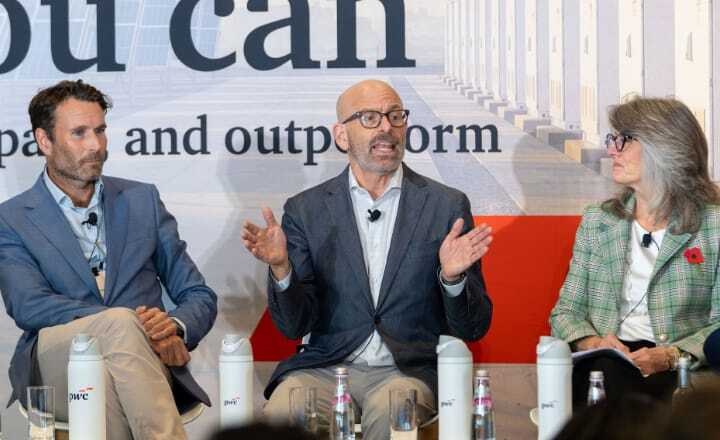 The panel was moderated by Sean Kelly, Partner, Insurance, PwC Bermuda. He was joined by insurance-linked securities experts, Chris Parry, Senior VP and Global Head of Capital Partners at RenaissanceRe Capital Partners; Michael Millette, Co-Founder & Managing Partner at Hudson Structured Capital Management Ltd; and Kathleen Faries, CEO at Artex Capital Solutions.
Kicking off the discussion, Kelly asked the panelists to look back at how much the relationship between insurance and the capital markets has changed over the past 30 years.
“Today we are definitely living in the catastrophe sector in a world where the capital markets capacity is important side by side with the traditional market,” said Millette.
He estimated that capital markets provide about $140 billion of the roughly $500 billion in global catastrophe limits, with a particularly significant role in Florida and retrocession.
But the opportunity discussed by the panel extends beyond catastrophe risk. Millette pointed to the growing participation of alternative asset managers in life insurance, as well as early capital markets involvement in casualty and cyber.
The shift, he said, reflects a change in how the industry views its relationship with traditional insurers.
“The rhetoric of the late ’90s was a rhetoric of competition. You know, will these capital markets guys drive the traditional market out of business, or do they not know what they’re doing? A lot of back and forth, and the rhetoric today is of side-by-side. It’s a rhetoric of bulk capacity in the capital markets, underwriting in the insurance markets, that has become, in some ways, very functional and potentially very elegant,” Millette explained.
That expansion is also changing the investor base, as Parry said the insurance-linked securities market has moved from attracting more opportunistic investors toward working with long-term pools of capital, including pension funds and sovereign wealth funds.
Those investors, he said, are more inclined to take a “holistic view when it comes to partnerships.”
“And I think that’s a very different conversation we’re having now with our investors than we would have done even pre the 2017/2018 soft market. So those conversations have evolved tremendously, and I think it allows you to think more long-term, obviously, but also just the more expansive nature of those conversations with the type of investors,” he added.
For some ILS investors, the appeal remains diversification, with Millette emphasising that the value of non-correlation has risen as investors have seen traditional assets such as stocks and bonds move in the same direction.
“25 years ago, pensions and endowments counted on stocks and bonds not to move the same way, such that they could get some buffer in their portfolio. 2022, we saw both stock and bond markets take a wallop at the same time. Lately, they’ve risen at the same time. Investors really crave diversification and non-correlation has gained in value, and that’s part of the reason,” Millette said.
He continued: “It’s been a good story. It hasn’t been perfect, and it’s important that it hasn’t been perfect. But we had a messy period in the cat market from 2017 to 2022, we had a long spell of nasty weather and fierce wildfires, and investors came back quickly, and they did for all sorts of reasons. But they especially came back because the value of non-correlation is more important than it ever used to be for long-term investors.”
However, the market’s evolution is not limited to risks that are uncorrelated with financial markets. Parry underlined that investors are increasingly considering areas such as credit, cyber and specialty, where correlation may be higher, alongside catastrophe exposure.
The next stage of the market’s evolution may depend less on attracting capital than on building the efficient structures to deploy it, as Faries argues that expanding into more complex risks requires the right expertise, continued investor education and infrastructure that can support efficient execution.
“If we’re going to go beyond property cat, which we are, I think we do need different pools of capital that have different risk appetites, different liquidity perspectives and different duration appetites. So it’s going to be super important that we move beyond what maybe was the type of ILS investor that we’ve had in the past, and that is happening,” Faries said.
“I think there’s a lot of examples of that. If you think about Bermuda as maybe being over the last 30 years that window into accessing cat risk. Now we have obviously London with London Bridge 2 where now we’ve got a window into specialty risk, which is a very different investment with a lot more complexity.”
“So there’s a lot more things that we have to think about again. But we do need different capital to be able to bring capital to those types of risks,” she continued.
“So I think it’s a super interesting time. But again, what made London Bridge 2 successful, in my view is they were thinking about what is the infrastructure that we need that’s going to maintain good trust, good execution, and make it efficient. So again, I think we just have to be thinking about what we need to do to make sure that we can scale the way that we did with property cat in casualty, in specialty and in cyber.”
 View all of our Artemis Live video interviews and subscribe to our podcast.
All of our Artemis Live insurance-linked securities (ILS), catastrophe bonds and reinsurance video content and video interviews can be accessed online.
Our Artemis Live podcast can be subscribed to using the typical podcast services providers, including Apple, Google, Spotify and more.