



Global gross domestic product (GDP) exposure to damaging severe convective storm (SCS) winds is projected to grow 14% over the next 30 years, reaching $20.2 trillion as climate risks continue to reshape underwriting globally, according to a new report by First Street, the climate risk financial modeling provider.
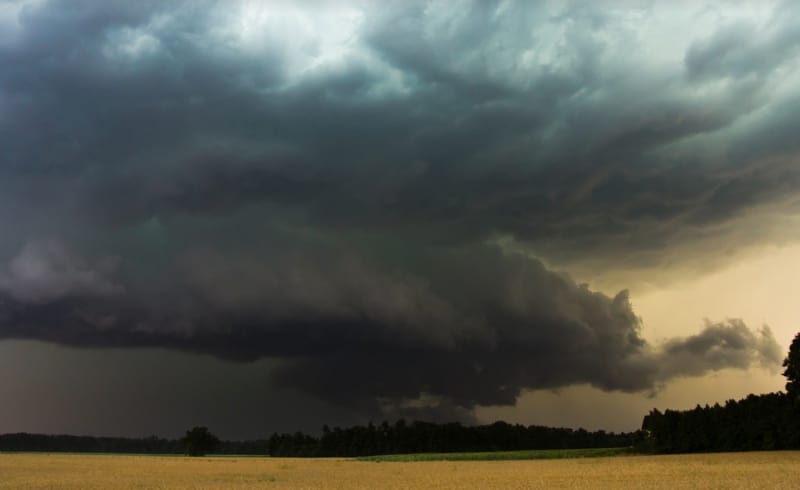 A recent report published by the firm highlights how SCS has evolved into one of the fastest-growing physical climate risks, and the single costliest insured peril of the 21st century.
In 2025 alone, SCS generated approximately $82 billion in global economic losses, representing nearly one-third of all natural catastrophe losses worldwide.
For the first time, cumulative insured losses from SCS events have overtaken those from tropical cyclones, First Street stated.
Data from the firm’s report shows that currently $17.8 trillion in annual GDP, or 9.8% of global economic output, along with roughly 907 million people, are exposed each year to damaging SCS winds of at least 65 mph.
In addition, $10.6 trillion in GDP, or 5.8% of global economic output, along with roughly 567 million people, are exposed each year to damaging hail of one inch or greater, which is expected to rise to $10.8 trillion over the next three decades.
Further data from First Street shows that the Americas have the highest relative exposure to SCS, with 13.6% of regional GDP exposed annually at risk from damaging winds and 11.2% from hail. These figures represent the largest proportions of any region, influenced by the intersection of severe storm climatology and high-value insured assets throughout the United States.
Notably, Texas alone holds the single largest concentration of hail-exposed GDP globally.
In addition, First Street noted that Asia-Pacific holds the largest absolute exposure to SCS, with $10 trillion in GDP exposed to damaging wind and $4.3 trillion to hail, spanning globally significant manufacturing and logistics hubs such as Jiangsu, Guangdong, and Taiwan.
Importantly, First Street highlighted that climate change is anticipated to accelerate exposure to damaging winds, with projections indicating increases of over 18% in the Asia-Pacific region and approximately 14% across Europe, the Middle East, and Africa within the next three decades.
This trend is expected to broaden material SCS risk into markets that have traditionally not received substantial underwriting focus in the past.
Interestingly, on a frequent-event basis, so a 1-in-20-year storm, First Street notes that 62% of global GDP is exposed to damaging SCS winds and 52% to damaging hail, which clearly indicates that these hazards are reaching a majority of the world’s economy, and not just isolated regions.
The findings from the report are supported by First Street’s global SCS hazard models, which integrate physically based layers of hail, severe thunderstorm winds, and tornadoes with consistent measures of population and economic activity across various event probabilities and climate scenarios.
First Street’s data also coincides with recent broker H1 2026 catastrophe loss reports, which have reinforced SCS as this year’s primary loss driver for the global insurance and reinsurance market, even in a quieter period for the peril.
Gallagher Re recently estimated that around $26 billion of its $46 billion global insured catastrophe total for H1’26 stemmed from SCS events, with the broker calling it North America’s costliest peril.
Similarly, Aon explained in its own report, that severe convective storms were the costliest peril overall, driving approximately $40 billion in global economic losses for the same period.
The broker also pegged insured losses from U.S. severe convective storms at approximately $27 billion for H1 2026, with the most significant event during this period being an SCS outbreak from April 23rd to 29th, which resulted in more than $5 billion in insured losses
Matthew Eby, CEO of First Street, commented: “For too long, severe convective storms have been priced as background noise: small, local events that diversification was assumed to absorb.
“This research shows the opposite. When you map these hazards against where the world actually produces economic value, SCS is a recurring, correlated risk sitting on top of trillions of dollars in GDP. Making that visible is the first step to pricing it correctly.”
Dr. Jeremy Porter, Chief Economist at First Street, added: “Severe convective storm exposure is concentrated in the most productive parts of the global economy, and it’s expanding, particularly for damaging wind across Asia-Pacific and Europe.
“The takeaway for investors, lenders, and insurers is clear: SCS can no longer be treated as a secondary peril. It belongs in due diligence, stress testing, and long-term asset performance assumptions alongside hurricanes and wildfire.”
Severe convective storm (SCS) is a peril frequently covered in the catastrophe bond market, with numerous US multi-peril cat bonds having exposure to SCS events, as well as some covering risks in Europe.
 View all of our Artemis Live video interviews and subscribe to our podcast.
All of our Artemis Live insurance-linked securities (ILS), catastrophe bonds and reinsurance video content and video interviews can be accessed online.
Our Artemis Live podcast can be subscribed to using the typical podcast services providers, including Apple, Google, Spotify and more.