




Catastrophe bond insurance risk spreads declined further in October 2026, as seasonal tightening continued to affect the overall yield of the cat bond market. Cat bond risk spreads now stand at their lowest since 2017 and while the tightening trend will end soon, it remains to be seen how lower spreads of new issuance affect the market yield going forwards.
The latest data on cat bond yields from Plenum Investments shows that the typical hurricane seasonal spread tightening continued last month, while with new issuance picking up again the expected loss of the cat bond market had increased in October as well.
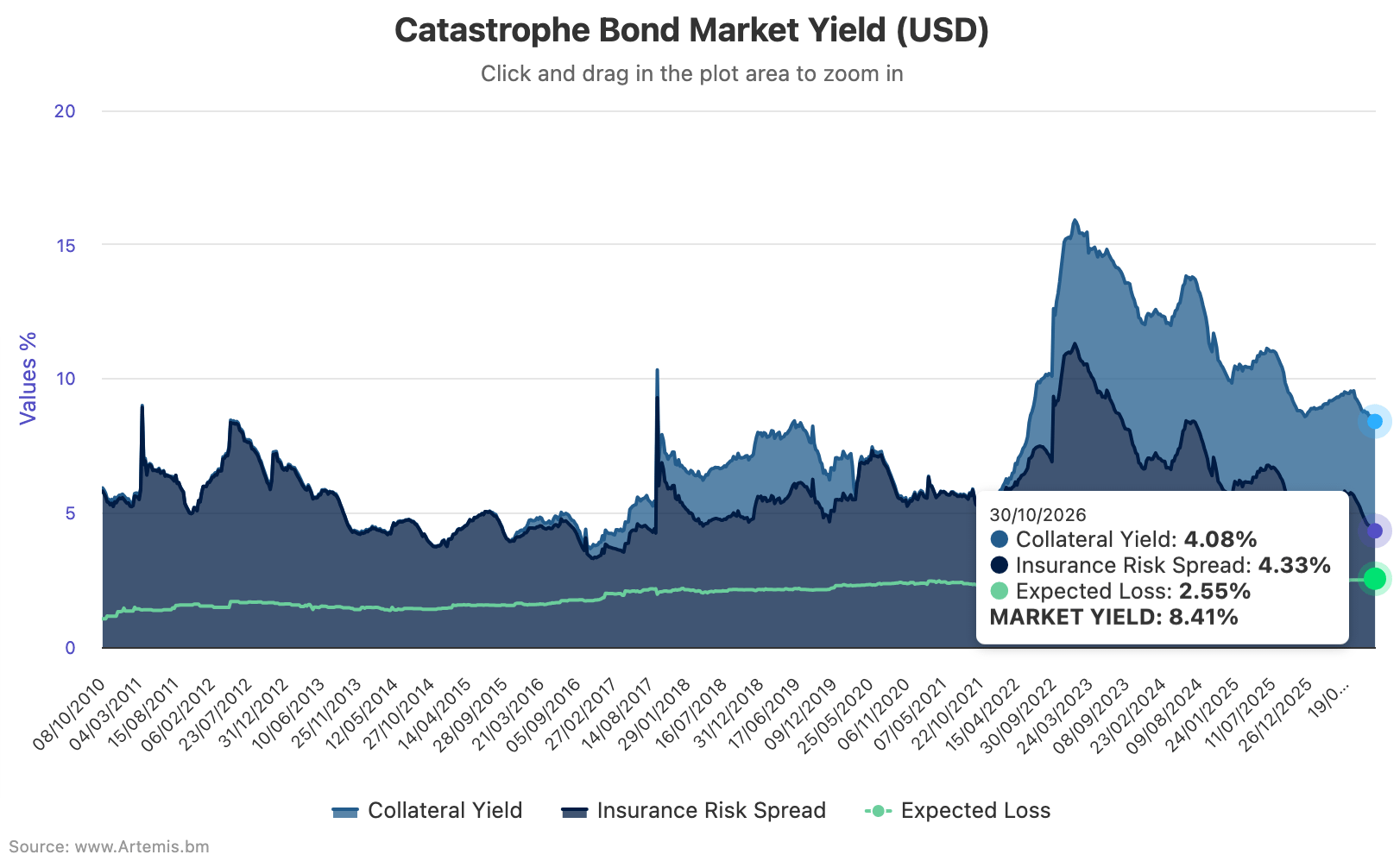
As a result, by October 30th, the overall coupon yield of the catastrophe bond market had fallen to 8.41%, which is down from the September 25th figure of 8.74%.
The insurance risk spread of the outstanding cat bond market now stands at 4.33% at October 30th 2026, which is down roughly 13% on the same time last year.
The last time cat bond market risk spreads fell this low was in August 2017, according to Plenum Investments’ data, although it’s worth noting that was after they had increased from as low as 3.3% in November 2016.
The overall cat bond market coupon yield of 8.41% is down approximately 4.5%, less of a decline than insurance risk spreads alone due to the fact the USD money market rate was lower a year ago.
It’s worth considering though that the expected loss of the cat bond market was measured at 2.25% on October 31st 2025, but by October 30th 2026 this stood at 2.55%, showing a little more risk is being assumed due to the profile of catastrophe bonds in the outstanding market at this time.
Click the chart below to analyse the interactive data:
Plenum Investments commented on the end of October update, “Total returns in the CAT bond market varied by currency, ranging from 8.4% (previous month: 8.7%) in USD, to 7.0% in EUR (previous month: 7.2%), and 4.2% in CHF (previous month: 4.5%).
“Spread tightening continued in October, with spreads narrowing by a further 5%. However, the pace of tightening is slowing, as expected towards the end of the hurricane season. This trend is likely to persist at a more moderate pace into November, before spreads are expected to start widening again in December.”
While spread widening is expected to begin again given the seasonality of premiums and returns in the catastrophe bond market, as we said the question is how the market yield bounces back given the inclusion of lower-priced cat bonds issued during this softer phase of the market cycle.
While seasonality affects the insurance risk spread of the cat bond market, so too does the average spread across all deals outstanding and so newer issues will begin to increasingly show in the data.
They are already showing the in expected loss of the cat bond market, which has risen in recent weeks. Although we should also note that maturities also affect that metric, as the composition of the cat bond market changes.
With the cat bond market pipeline now building steadily and fourth-quarter looking to be another strong period of issuance, greater visibility of how new issues affect market metrics will be visible in the coming month or two.
It’s also important to remember the contribution of the risk-free return on collateral, which boosts overall coupon yields considerably for the cat bond market.
When risk spreads bottomed out in 2016, the total yield of the catastrophe bond market, or the coupon available to cat bond investors, fell to as low as around 3.70%. Today, the collateral yield is 4.08% on its own, so added to a 4.33% risk spread gives the total coupon return of 8.41% as of now.
Looking at the catastrophe bond market’s return over expected loss, so the expected excess return of sorts, today that stands at 5.86% as of October 30th, down from 6.24% as of September 25th.
But, in the depths of the soft reinsurance market in 2016 when cat bond risk spreads hit their lowest-level ever, even with the expected loss being lower at that time, the cat bond market yield over expected loss was actually below 2%.
So, comparably, spreads and yields of the catastrophe bond market are much higher today than they fell to in the last soft reinsurance market.
With catastrophe bonds still seen as a beneficial diversifier and source of relatively uncorrelated returns for investment portfolios, it’s perhaps no surprise investor appetite remains strong, even as pricing has fallen.
Analyse catastrophe bond market yields over time using this chart.
 View all of our Artemis Live video interviews and subscribe to our podcast.
All of our Artemis Live insurance-linked securities (ILS), catastrophe bonds and reinsurance video content and video interviews can be accessed online.
Our Artemis Live podcast can be subscribed to using the typical podcast services providers, including Apple, Google, Spotify and more.