



Over the last year and through the record-levels of issuance in 2026 so far, the catastrophe bond market’s outstanding exposure has shifted further towards indemnity triggers and per-occurrence coverage, as preference for these types of deals continues to rise, both on the sponsor and investor side.
Using Artemis’ extensive catastrophe bond database, we can visualise this shift towards indemnity reinsurance protection and away from aggregate reinsurance and retrocessional risks in cat bond form.
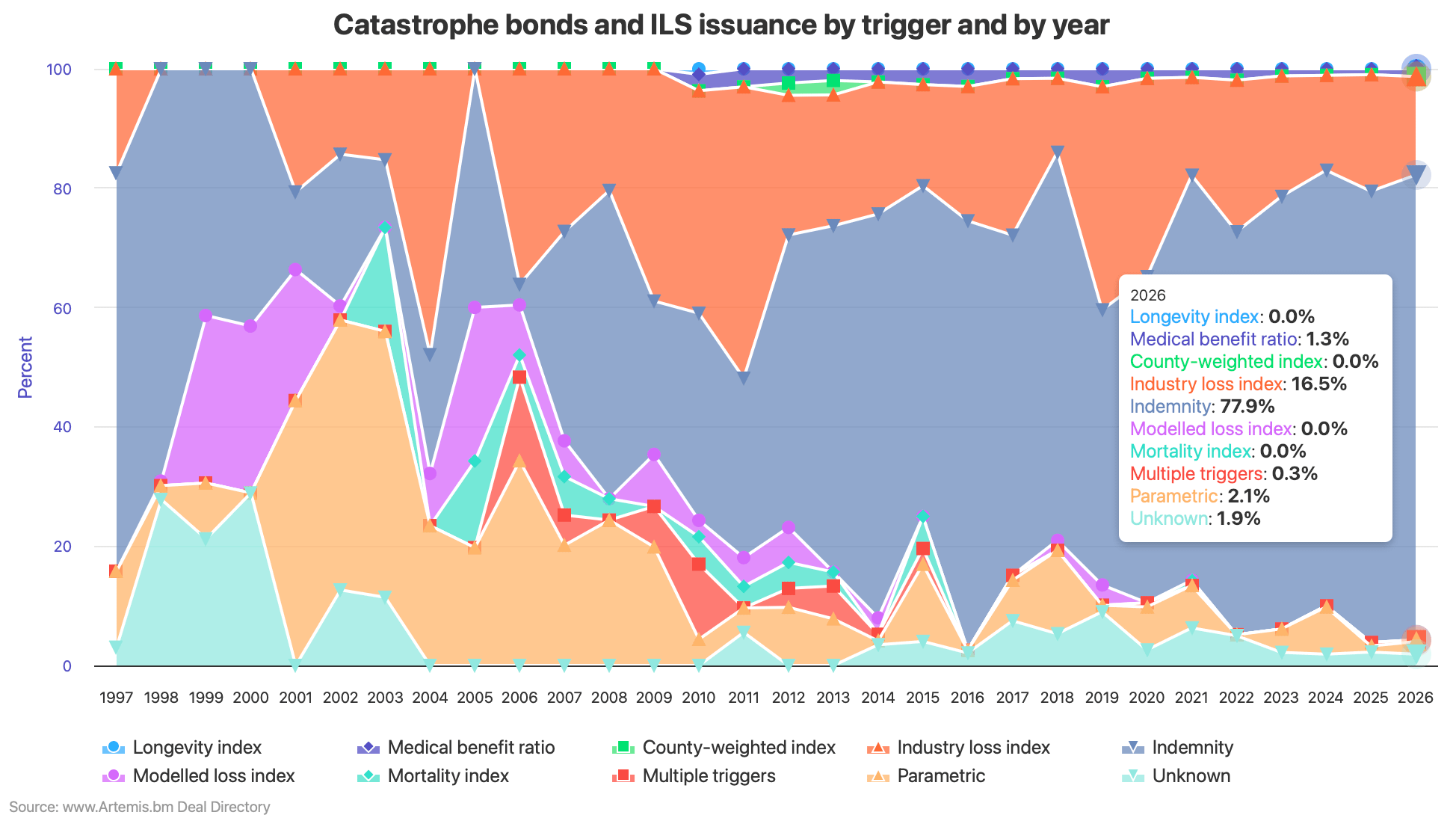
While catastrophe bond issuance has been increasing rapidly in recent years, the triggers used for cat bonds have moved towards a clear preference for indemnity protection.
In fact, for 2026 so far almost 78% of cat bond limit issued and tracked by Artemis features an indemnity trigger.
Notably, that is the highest figure for any year in the market’s history and through the recent records that have been set in the cat bond market, in 2022 issuance volumes were 67.5% indemnity triggered, in 2023 it was 72.5% indemnity, in 2024 73% indemnity and 2025 75.6% of cat bonds volumes we analysed had an indemnity trigger.
You can analyse the mix of triggers used in catastrophe bond market issuance by year in this chart:
A key driver of this has been the steady and rising flow of new market entrants and first time catastrophe bond sponsors, many of which have been primary insurers in the last few years.
We’ve already tracked cat bonds issued on behalf of 14 first-time sponsors in 2026 so far, so this year looks likely to set a new record and beat last year’s 15 new cat bond sponsors in full-year 2025.
While there is clear evidence of growing uptake of cat bonds as component’s of primary insurers reinsurance arrangements, one key factor in this growing indemnity trigger preference has been the shifting of risk away from residual markets to private insurers, such as we’ve been documenting over the last few years in Florida with the down-sizing of Citizens there.
Primary insurers typically prefer an indemnity structure, to more closely align cat bond cover with their traditional reinsurance arrangements.
Which leads nicely onto a discussion of the growing preference for exposure to per-occurrence covers in the catastrophe bond market, as naturally a growing sponsor base of primary insurers prefer to utilise cat bond coverage in that form so that plays into this market dynamic as well.
But, just as importantly, the investor base has shown a preference for per-occurrence coverage in catastrophe bonds as well, not least since the years when lower deductibles and retentions, as well as more expansive peril classifications and coverage, had resulted in losses to aggregate structures more frequently than occurrence.
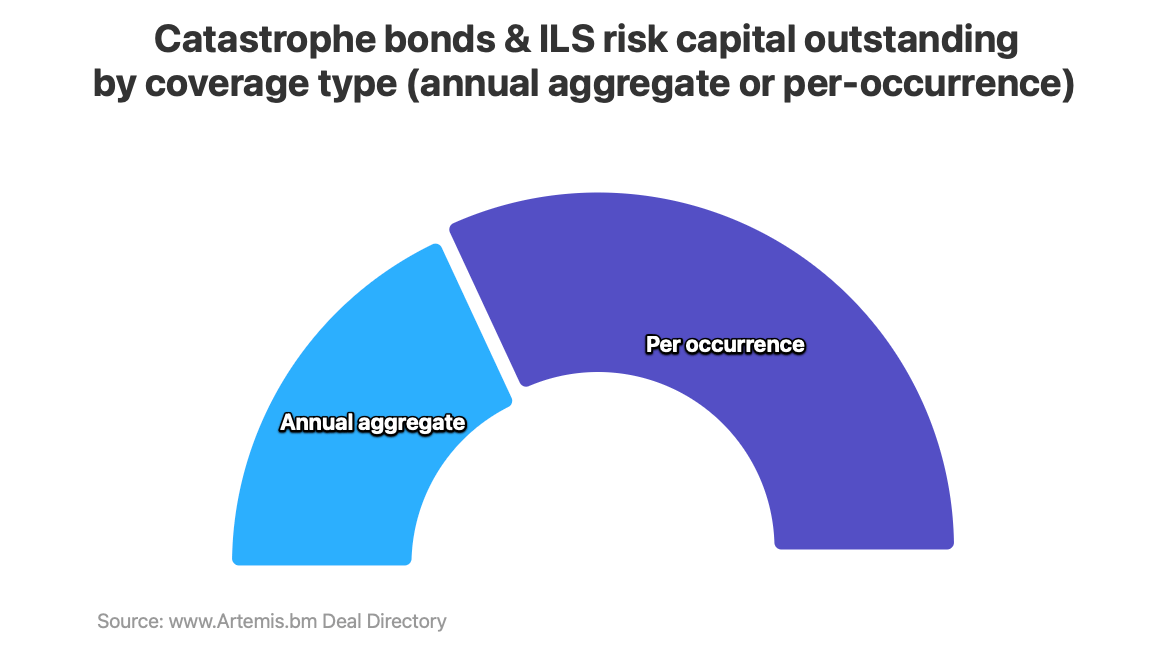
As recently as 2021, the catastrophe bond market risk capital outstanding provided more aggregate reinsurance limit than occurrence, but since then the prevalence of aggregate cat bonds in the market has been shrinking.
Using Artemis’ range of catastrophe bond and insurance-linked securities (ILS) charts and visualisations, we can clearly watch this trend developing.
The percentage of the outstanding catastrophe bond market made up of aggregate cat bond notes was still as high as 58% in March 2019. But it had slipped to 51% as of June 2021, then fell below 50% for the first time by November of that year.
The shift continued and by the mid-point of 2023 only 47.4% of total cat bond risk capital outstanding was backing an aggregate limit of coverage.
By the end of 2023 aggregate notes slipped to just 41.7% of the outstanding market and the trend continued so that roughly one-year ago the market consisted of just 39.4% aggregate cat bond notes with the rest per-occurrence.
Now, as of this week, Artemis’ data on the aggregate and occurrence split of the cat bond market shows that aggregate deals have declined further as a proportion of the market, now making up only 36.1% of limits, while per-occurrence cat bond notes make up 63.9% of the market’s risk capital outstanding.
While the investor base and cat bond fund managers, have clearly had a preference for occurrence structured cat bond investments in recent years, we have noted some more aggregate deals coming to market in the second-quarter.
However, these have been outweighed by a number of large indemnity, per-occurrence cat bonds that were issued, so further shrinking the proportion of the cat bond market that provides annual aggregate protection to sponsors.
The data supporting our charts has been collected by Artemis over the full-history of the catastrophe bond market and is now supported by information on almost $224 billion of issuance, all of which is has been sourced, tracked and analysed by us and is contained in the Artemis Deal Directory.
You can access all of Artemis’ catastrophe bond market reports here and analyse our data using the charts and visualisations you can find here.
 View all of our Artemis Live video interviews and subscribe to our podcast.
All of our Artemis Live insurance-linked securities (ILS), catastrophe bonds and reinsurance video content and video interviews can be accessed online.
Our Artemis Live podcast can be subscribed to using the typical podcast services providers, including Apple, Google, Spotify and more.