



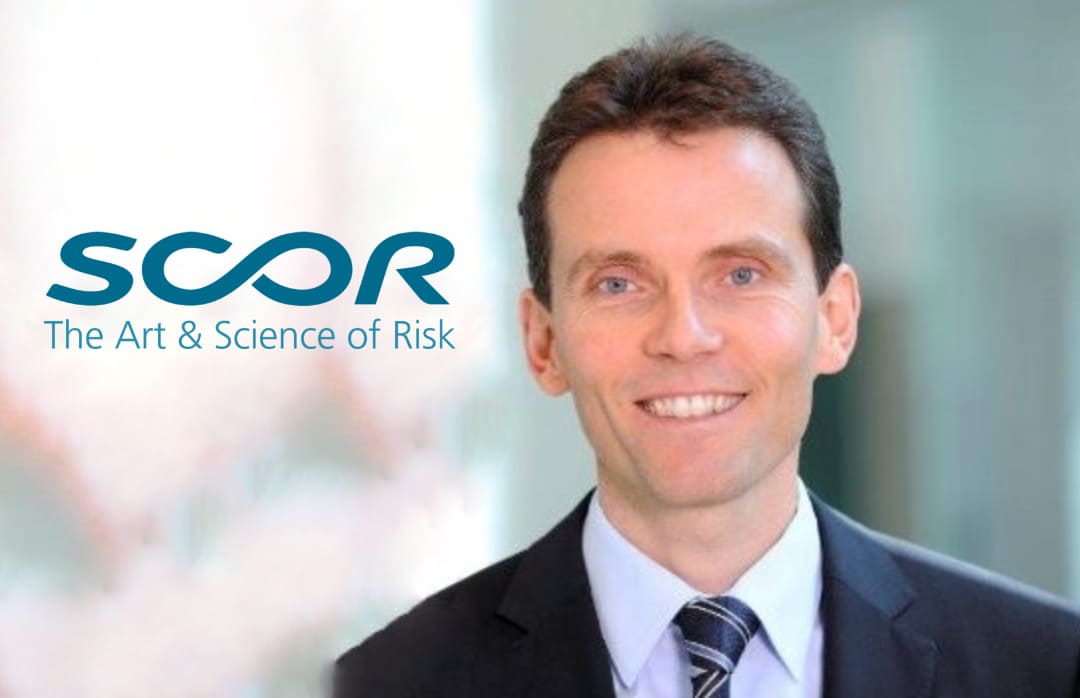
Thierry Léger, Chief Executive Officer (CEO) of global reinsurance firm SCOR, explained this morning that while the market is more competitive, with a proliferation of new capital entering, he sees this as an opportunity for the company, while suggesting that if there are better ways to match risk and capital they should be exploited.
 As our sister publication Reinsurance News reported earlier, SCOR delivered net income of €206 million in the third quarter of 2026, driven by a strong group performance including a 3.5% rise in P&C insurance revenue to €1.9 billion and a combined ratio of 84.1%.
SCOR’s results did highlight “deteriorating reinsurance margins” though, which is inevitable in a softened and highly competitive market environment.
But the reinsurer’s CEO feels there are still attractive opportunities to be had, while the developments seen in the marketplace should not necessarily be viewed as negative.
Commenting on the outlook for the end of year reinsurance renewals, Léger said, “Our P&C teams are now fully-focused on the 1st of January 2027 renewals. We expect competition to remain high and have a clear priority for our underwriters, margin and quality over volume. Over recent years, we have strengthened our capital discipline, remaining very selective and deploying capital only when risk-return is attractive. In the last weeks, we announced the exit of U.S. casualty and space of our direct insurance business due to lack of adequate margins and an unchanged negative outlook for these lines of business. Our tier one franchise technical expertise across P&C and life and health, and our strategic capital allocation to diversifying and profitable lines of business position us well ahead of the next strategic cycle and to navigate market headwinds.”
Later during the call he was asked about how competition shows up in SCOR’s results, on which Léger acknowledged the inevitability that effects will be seen over-time.
“Imagine it’s like a wave coming, and it’s coming also for us. So those results will slowly earn through IFRS 17, slowly earn through our quarterly results in the one to two years to come. We feel still limited impact from it, it’s still a bit too early, but we will see it next year, then the year after.
“So there is pressure on the margins and we have been able to compensate the pressure with a bit more volume. So if you multiply volume times margins, we are still in a very good spot, and that’s really what we call portfolio steering.
“We really try to steer our portfolio in the best possible way, allocate capacity, capital to the most attractive portfolios in a very dynamic way that allows us to still find attractive areas to grow.
“But as I said at the beginning, we are in a more competitive environment. That’s what we are preparing for. I think that SCOR has very good cards to continue to write profitable business in the year to come.”
During the call, Léger was asked for his views on broker-led reinsurance facilities in the market, which the CEO linked together with third-party capital and explained that it’s not necessarily all bad for the reinsurers.
“On the broker-led reinsurance facilities, first of all we think that competition is there for a reason, right? I mean, if there are different ways, better ways to conduct business, then I think that’s what competition is here for. These things have to be exploited, these opportunitie,” Léger said.
Continuing to explain that, “We see quite a dynamic and quite active broker environment, coming up with facilities that they haven’t maybe presented before. They’re using third-party capital in a way they haven’t done before, and so it’s not just the type of structures, they’re not new, but maybe the quantity of which come up right now probably a big link to the softening market.
“However, for SCOR, we are always looking at those as an opportunity, what can we learn from it, what can we apply to us and how can we position SCOR in a nimble way to actually make those developments an opportunity.
“So far, I would say it is much more in our camp now to react to it and understand what’s going on. I’m pretty confident that we will be able to make it an opportunity for SCOR, accepting that the environment is what it is, and we have to adapt and we have to make the best out of it.”
SCOR is already utilising third-party capital within its business in numerous ways, from its retrocession purchases, to risk-sharing arrangements and of course its asset management arm SCOR Investment Partners through its insurance-linked securities (ILS) funds.
During the Monte Carlo reinsurance event, Léger had said that the reinsurer sees third-party capital as an attractive source of capital for the firm, and sees no future changes regarding its strategy for managing it.
Naturally, the largest reinsurance companies in the world have sufficient access to underwriting flow, as well as the data to support major investors entry into the market in support of their business, which positions players like SCOR to lean more heavily on third-party investors should they choose to.
At a time when brokers are pulling significant new capital into a softening market, the reinsurers natural and best response may be to identify how these trends can be leant into, to help them make their own businesses more efficient as well.
 View all of our Artemis Live video interviews and subscribe to our podcast.
All of our Artemis Live insurance-linked securities (ILS), catastrophe bonds and reinsurance video content and video interviews can be accessed online.
Our Artemis Live podcast can be subscribed to using the typical podcast services providers, including Apple, Google, Spotify and more.