




After yesterday’s magnitude 6.8 earthquake in the Kumamoto prefecture of Japan a number of specialist insurance-linked securities investment managers have commented, with all analysis seen so far indicating this is currently viewed as unlikely to be a loss event of particular note for the catastrophe bond and ILS market.
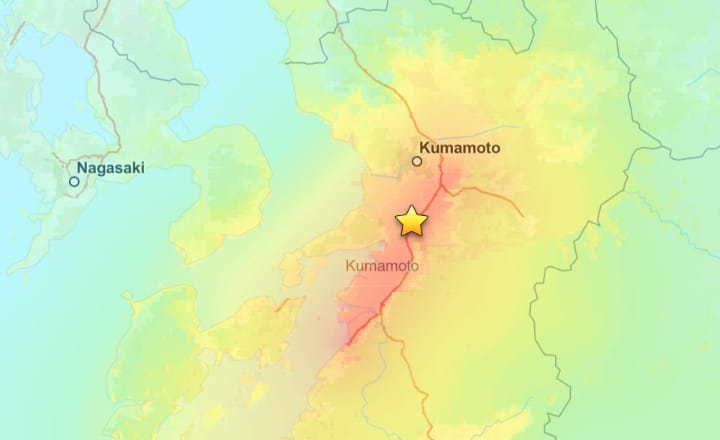 As time passed and more reporting was available following the earthquake it became clearer that, while not one of the most catastrophic earthquake events, Tuesday’s quake in Japan has resulted in damage to properties and infrastructure across the affected area, sadly also being severe enough to cause loss of life.
Currently, Japanese authorities have reported 13 deaths due to yesterday’s M6.8 earthquake in the Kumamoto prefecture, while emergency rescue efforts continue at the collapsed Aeon shopping mall where four people remain missing, as well as at a Nippon Paper factory in Yatsushiro. In addition, a number of industrial factories and chip manufacturers that have operations in the region have paused activities while impacts continues to be assessed.
Property damage is widespread across the region and insurance claims will follow, all of which will add to the industry toll from this quake. The relatively shallow depth of the earthquake means its impacts are set to be relatively meaningful, for an earthquake of this magnitude.
Following the event, ILS investment managers have been analysing the impacts of the quake, running their models and seeking to identify how impactful the earthquake will be to the insurance and reinsurance market, as well as to the positions their funds hold that may be exposed to a Japanese earthquake event.
We’ve seen a number of reports now from specialist ILS managers.
Euler ILS Partners, the Zurich-based specialist investment manager, produced an event report that provides a detailed analysis of the event.
Firstly, Euler ILS Partners estimates that the insurance industry loss from this earthquake in Kumamoto could fall between US $3 billion and $4.5 billion.
However, at that level of impact to the global insurance and reinsurance industry, Euler ILS Partners said it does not expect any impact to the positions held by its fund.
As with any meaningful insured loss event, there could be implications for certain aggregate reinsurance and retro structures, including ILS positions structured in this manner, Euler ILS Partners also noted.
The specialist ILS investment manager stated, “At this stage, we do not expect any direct impact on the positions held within the fund. Nevertheless, the event remains relevant for certain aggregate reinsurance structures, where losses from this event may contribute to the erosion of aggregate retentions or deductibles.
“We are actively monitoring the situation, reviewing the exposure of all relevant transactions and maintaining close dialogue with cedants, brokers and modeling partners. Should there be significant implications for our portfolios arising from this event, we will communicate additional information as appropriate.”
The investment manager also highlighted that the 2016 Kumamoto earthquake sequence, which culminated in an M7.0 earthquake, generated insured losses estimated at between US $3.9 billion and $5.5 billion.
Commenting on the potential industry loss from this week’s earthquake in Japan, Euler ILS Partners explained, “Based on the information currently available, our preliminary assessment indicates that insured losses from today’s event are likely to fall between USD 3.0 billion and USD 4.5 billion, although this estimate remains subject to considerable uncertainty and may evolve as additional information becomes available. We expect total economic losses to be materially higher than insured losses.”
As Euler ILS Partners explained, it will take time for the industry impact to become clearer, but this early analysis by the ILS manager is a useful starting point range.
Also commenting on the July 2026 Kumamoto earthquake, specialist catastrophe bond investment manager Icosa Investments AG stated that memories of the 2016 event and the fact Japan is a peak peril region for earthquake risks means “today’s event will draw close attention from cat bond investors.”
Icosa Investments further commented, “Roughly USD 2 billion of cat bond insured limit are exposed solely to Japanese earthquake with further exposure held in Japanese and international multi-peril deals.
“That said, these structures are generally calibrated to more intense events than this, and much of the exposure is indemnity-triggered and weighted toward residential property. Initial assessments points to a low likelihood of significant market impact.
“The main caveat is that indemnity triggers leave some residual uncertainty until ground-truth damage data emerges, so the team is actively monitoring reporting agencies and model vendors and will share a further updates with investors should this assessment materially change.”
Finally, Isacco Loconte, an ILS Investment Specialist at asset manager Azimut Switzerland SA, noted that, “this quake carries severe destructive potential due to its shallow depth of just 10km.”
On cat bond exposure Loconte added, “Looking at the ILS market, we currently track 14 positions at risk—though some feature only a marginal expected loss contribution from the Japan EQ peril. Combined, these tranches represent approximately $2B in exposed principal.”
Explaining his analysis of potential catastrophe bond exposure to the earthquake, Loconte said, “To estimate the potential market loss, we analyzed the AIR Stochastic Catalog, filtering for simulated events within Kumamoto Prefecture with a magnitude of Mw 6.8 (± 0.5).
“This filtering yielded a subset of 5,135 modeled events.
“In 82% of these scenarios, the resulting loss to the Cat Bond market is $50M or less.
“Given that the total outstanding Cat Bond market currently exceeds $50BN, a $50M impact is effectively negligible from a broader market capitalization perspective, suggesting that widespread principal impairment is highly unlikely.”
Update: Isacco Loconte provided details of a further analysis, saying,” Secondary filtering of the SSE events by distance (within a 20 km radius of the epicenter) and depth (under 15 km) isolates a subset of 13 events, none of which generate losses for Cat Bond investors.”
As the loss picture becomes clearer it will be better understood how much of the earthquake loss might flow to the reinsurance market, as well as whether any ILS positions are exposed.
While the catastrophe bond market exposure seems expected to be zero to very minimal, there are aggregate structures that may be impacted by retention erosion, as well as lower layer reinsurance or retrocession collateralized ILS instruments which could have greater potential to become exposed, should the industry insured losses from the earthquake prove higher than currently anticipated.
It’s important to note that it remains very early in terms of damage assessments and a clearer picture of losses will take time to emerge, so the industry’s analysis of this earthquake will continue as more information becomes available.
Reinsurance broker Howden Re has also commented on this earthquake, with its Japan leader Kentaro Tada, CEO of Howden Re Japan, saying that, “It’s too early for formal estimates, but we’d expect insured losses to remain well below the 2016 Kumamoto earthquake and closer to the 2024 Noto earthquake, unless the aftershock sequence reveals more extensive damage.”
Also read: Japan quake impact on cat bonds, private ILS not expected to be material: Twelve Securis.
 View all of our Artemis Live video interviews and subscribe to our podcast.
All of our Artemis Live insurance-linked securities (ILS), catastrophe bonds and reinsurance video content and video interviews can be accessed online.
Our Artemis Live podcast can be subscribed to using the typical podcast services providers, including Apple, Google, Spotify and more.