



The connectivity between risks in an increasingly complex world means their consequences can be amplified. As the insurance and reinsurance industry work to understand emerging risks, there’s a need to build the conviction and confidence of all stakeholders including capital providers, so risks can be effectively transferred, according to Moody’s CEO Rob Fauber.
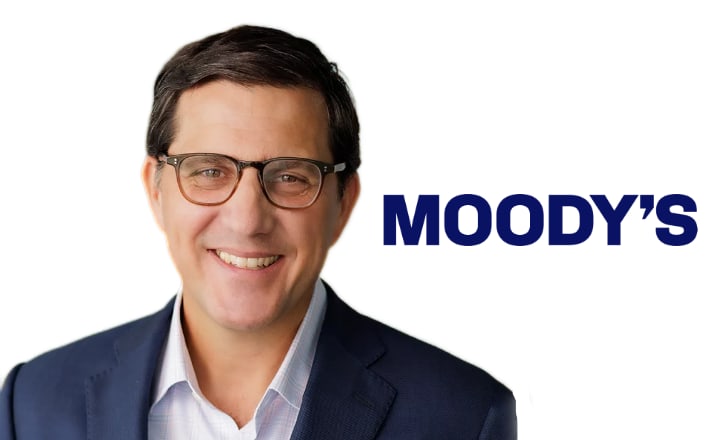 Fauber was speaking in Monte Carlo this week at a Moody’s hosted briefing focused on the emerging risks being faced by the global economy and society during the 2026 Rendez-vous event.
He hosted a panel discussion with industry leaders, where the size of the capital pools waiting on the sidelines of reinsurance was highlighted once again and Fauber explained that the industry needs to help capital understand the opportunity and put understanding around it, to give providers the ability to come into the sector with confidence.
Fauber explained the back-drop to the discussion, saying, “Risk and opportunity are two sides of the same coin. It’s easy to see them as just a separate, discrete list of risks, but that’s not really how risk reaches us any more. These risks, increasingly they collide and they amplify each other, and we’ve we’ve seen many examples of that, and they travel through a very deeply-connected global system, that’s got a speed and a reach that can turn what begins as a localised issue into something far greater.
“At Moody’s, we’ve coined this term called exponential risk. That’s the way these risks interact with each other and it doesn’t mean necessarily that there are just more risks or the risks are bigger. In some cases that’s true, but it does mean that the connection among the risks can multiply their consequences, and I think that’s a very important concept.”
Explaining how this connectivity and interlinked nature of emerging risks manifest is rife with uncertainty.
He said, “A physical event can impact infrastructure and supply chains. That can then impact businesses, it can impact credit conditions, it can impact communities. You can have the additional impact of technological disruption, and then when we have economic and geopolitical fragility, that often makes the system less able to absorb these kinds of events.
“The ultimate loss may ultimately emerge somewhere that’s different than where the original event began, and there are many examples of that in today’s world. That really is the defining challenge of this concept of exponential risk, that the risk that we see may not ultimately be the one that matters the most. What really matters is starting to understand this chain of consequences that gets set in motion. Especially when we have long-tailed risks.
“Obviously the insurance and reinsurance industry understands this better than most industries. I mean, you’re asked every single day to evaluate risks that don’t remain neatly within one peril or one line of business, or one geography, or even one time horizon. You’ve got to translate that understanding into underwriting and pricing, and portfolio and capital decisions, and you have to do that before this full pattern is visible.”
Later, Fauber highlighted the role of the industry in helping capital providers get up to speed on emerging risk opportunities.
“I tend to think of the protection gap as an addressable market opportunity. The question is how do you go after it?
“You’ve got issuers, you’ve got investors, you’ve got reinsurers, you’ve got rating agencies, you’ve got a lot of parties that are taking a view on these different risks, and in some cases, obviously taking different views.
“Ultimately, you’ve got to be able to get some sort of alignment across those parties to be able to raise capital. It goes back to this idea of, how do you build the conviction and confidence from these different stakeholders to be able to get these transactions done in areas that that may be newer?” Fauber stated.
As the session drew towards its close, Fauber summed up the opportunity by saying, “There’s a common theme here, and I’m encouraged about the role that we can play and partner with everybody around the data, the analytics and this idea of connected intelligence.
“It’s also important to remember, we’re going to end on a high note here, but when the industry gets it right, it’s not just the industry that’s thriving, but it’s the economy and broader society. The ability to fund resilience, and foster innovation and confidence in investments. All those things, this is a big societal role that this industry plays.
“If you think of this concept of the protection gap as an addressable market opportunity, obviously a societal need, but addressable market opportunity for the industry, it’s enormous. There’s a lot of uninsured risk, we all know that. That means there’s opportunity for everybody in this ecosystem to participate. The pie has the opportunity to be much, much larger.”
 View all of our Artemis Live video interviews and subscribe to our podcast.
All of our Artemis Live insurance-linked securities (ILS), catastrophe bonds and reinsurance video content and video interviews can be accessed online.
Our Artemis Live podcast can be subscribed to using the typical podcast services providers, including Apple, Google, Spotify and more.