



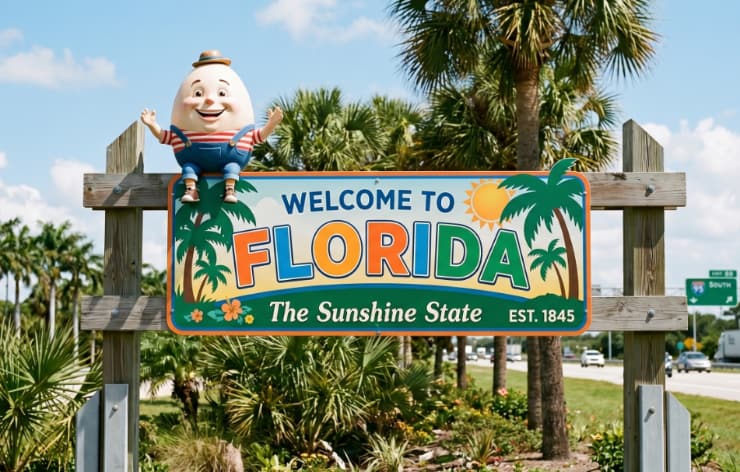
As reinsurance market conditions ease meaningfully for Florida based insurers at the mid-year renewals, an analyst report has cited American Integrity CEO Bob Ritchie as saying the easing is around more than just price, with improvements in terms and conditions suggesting “Humpty Dumpty is getting put back together.”
 TD Cowen analysts met with a number of insurance market participants in the Tampa Bay area recently, concluding that the Florida market is loosening at primary and reinsurance levels, while hearing of irrational behaviour from some newer market participants.
Reinsurance market dynamics have always been a driver for competitive tendencies in Florida’s insurance market and with more pronounced price softening being seen at these reinsurance renewals, with rates said down 15%+, it’s leading to weaker terms and conditions, the analysts said.
As usual, pricing is coming down fastest in the upper-layers of reinsurance towers, which of course is where the catastrophe bond market is most active and has been applying steady competition since long before the renewal signings, while in the lower-layers of towers reinsurance pricing is still seen as “stickier”, the TD Cowen analysts explained.
But, coverage is broadening at the mid-year reinsurance renewals, with exclusions easing and top-and-drop structures returning, which the analysts see as positive for the primary property insurance carriers in Florida.
Importantly for carriers at this time, the reinsurance tailwinds are helping to offset pressure on primary rates, as the insurance market becomes more competitive as well.
While the analyst suggested that, as reinsurance price declines outpace primary, carriers may be seeing some effective margin expansion at this time.
American Integrity Insurance CEO Bob Ritchie told the analysts that “Humpty Dumpty is getting put back together,” as reinsurance coverage options improve for protection buyers.
Reinsurance is generally covering more risks again in Florida, rather than excluding certain perils.
The return of top-and-drop structures, of which a few more are being seen in the catastrophe bond market along with other features typical of a softening market, is seen as a valuable coverage option that is becoming more available again for primary carriers.
While some markets have been pushing back on these features and in the cat bond fund space more managers seem to shun some them than accept them, the deals structured to provide this type of cover are still getting settled, generally at reduced pricing, thanks to the levels of capital in the industry.
“A top and drop program is where the primary carrier is able to “reuse” an excess-of-loss layer if it isn’t breached by a first event, acting as a reinstatement layer for lower layers after the first event,” TD Cowen’s analyst team explained.
The Humpty Dumpty character from the nursery rhyme is often used to describe something that is broken beyond all repair, or a fragile situation where putting the pieces back together is not possible.
Look back just a few years and likely very few people thought the reinsurance market would revert so rapidly in Florida to these softer conditions. The market peak after 2022 and subsequent trough has come around perhaps more quickly than most other cycles in reinsurance market history.
Which speaks to the improved situation in the Florida property insurance market (the legislative changes have clearly helped the market recovery), that has bolstered appetites for access to catastrophe risk in the state.
But also speaks to the weight of capital in the reinsurance industry, the acceleration of insurance-linked securities market growth and resulting elevated appetites to access new risk/return opportunities. Plus the cycle may have changed, given the increasing fungibility of capital (or amount of more fungible capital) compared to what the industry had previously been used to.
Predictions that the growth of ILS capital and increasing reinsurance efficiency from advanced technologies would flatten the market cycle have proved to be wrong, it seems.
While the nursery rhyme implies that Humpty Dumpty was irreparable, the questions when it comes to Florida’s reinsurance easing are: how long this phase of the cycle lasts; how far terms and conditions might stretch before it ends (as it inevitably will); what it might take to revert appetites for risk in the state; and, will the next hard market peak be as high as the last?
Sources are also telling us that some other terms and conditions have been loosening at the mid-year reinsurance renewals, with indications that contract features like the hours clause are also coming under some pressure. Once the renewals are finished, we’ll likely hear more as to how terms have become more accommodating for protection buyers from the broker reports and get better visibility of this.
The recent hard market resulted in terms perhaps shifting further and faster in the favour of reinsurance and ILS capital than at previous market peaks, so this current easing may be bringing loss sharing back into greater alignment for now.
It’s important to note that attachment points (considered all-important by many) are remaining relatively stable, with carriers having to pay commensurately to buy coverage lower-down where pricing has proven more sticky.
Other analyst teams, such as at BMO Capital Markets, have said they do not see terms and conditions as having moved much at this mid-year renewal.
But BMO’s analysts said that if the soft market persists then terms and conditions may begin to “crack” more meaningfully in 2027.
BMO’s analyst team said pressure on property catastrophe reinsurance will persist unless the market experiences at least $100 billion of losses, in their opinion.
As a result, their base case for 2027 is for a continued decline in reinsurance pricing, although at a less steep downwards trajectory than seen in 2026.
In every soft phase of the reinsurance market cycle, price is the first to move. But, once capital providers reach the bottom of their risk appetites on price, inevitably terms are the next to shift.
While reinsurers in general reported still acceptable pricing in US property catastrophe risks at renewals so far this year, given rates-on-line remain higher than their previous soft market trough, the question now is how much further can they go over the coming months if there are no really significant loss events around the world.
Which makes discipline and selectivity key, while the cycle remains in a softening phase.
Analyst’s eyes will therefore be on those growing strongly into the property reinsurance market at this time. As any sign of undisciplined underwriting could drive their outlook to become more negative, on the listed names they follow for their investor clients.
Read all of our reinsurance renewals news and analysis here.
 View all of our Artemis Live video interviews and subscribe to our podcast.
All of our Artemis Live insurance-linked securities (ILS), catastrophe bonds and reinsurance video content and video interviews can be accessed online.
Our Artemis Live podcast can be subscribed to using the typical podcast services providers, including Apple, Google, Spotify and more.