



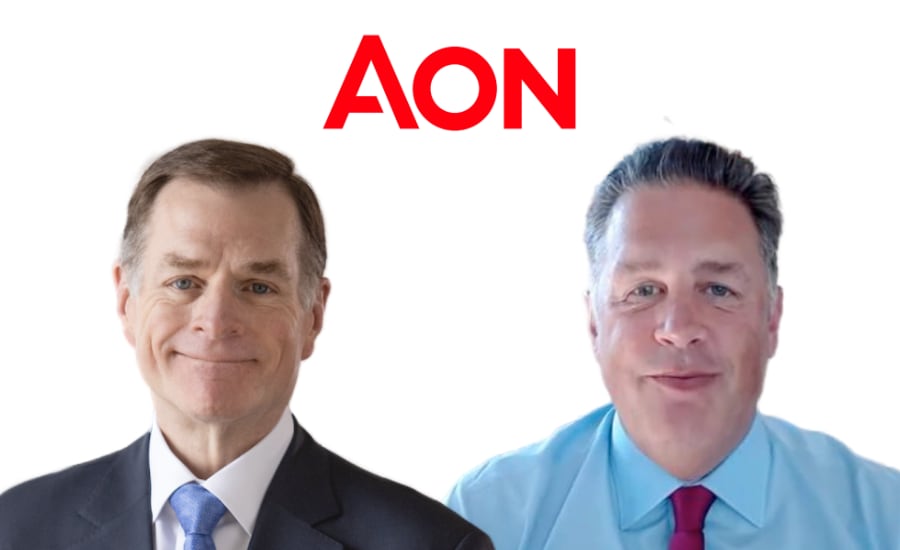
Greg Case, CEO and Andy Marcell, CEO of Risk Capital at insurance and reinsurance broker Aon, have highlighted that innovation and new alternative sources of capital are required to protect communities and assets, in bridging the gap between economic and insured catastrophe and climate losses.
 Aon reported today that 2024 insured catastrophe losses reached $145 billion around the globe, which is the sixth highest figure on record.
Some 60 percent of the economic loss total, of $368 billion, was not covered by insurance, leaving another significant protection gap for last year.
Aon urges for the industry and financial community to innovate and provide for greater insurability of climate risk, which the broker sees as key for economic resilience.
Andy Marcell, CEO of Risk Capital for Aon, commented that bringing new sources of capital is a key factor in increasing the amount of insurance in-force around the world.
“The insurance industry – and broader financial community – has the opportunity to bring new sources of capital to protect vulnerable communities and strengthen the global economy,” Marcell explained. “The collaboration between various stakeholders will be crucial in developing public-private partnerships and innovative insurance products that offer a sustainable way of closing the protection gap.”
Greg Case, CEO of Aon, also noted that, “To tackle rapidly changing climate risk, the (re)insurance industry must
accelerate innovation and access new forms of capital to respond to increasing and evolving risks.
“Parametrics, for example, are increasingly key to attracting new forms of capital and are helping clients mitigate uncertainty and recover faster after an event.
“The devastating events of 2024 underscore the significant economic toll of climate risk. Evidenced by the data in our report – and the tragic destruction in California at the beginning of 2025 – extreme weather remains a powerful force driving the complexity and volatility that businesses and communities face and emphasizes the urgent need for innovative solutions to address this growing challenge.”
Aon’s new catastrophe report shows that weather events are becoming more frequent and costly, with, the global insured losses of $145 billion in 2024 being some 54 percent above the 21st-century average.
In insured loss terms, hurricane Milton was seen as a $20 billion industry loss and hurricane Helene $17.5 billion, according to Aon’s figures.
But once again severe convective storm (SCS) losses were a key driver for the annual insured loss figure, responsible for some $61 billion, the second highest total for the SCS peril on record.
In addition, flooding across Europe drove more than $9 billion in insured catastrophe losses, according to Aon.
Aon CEO Case added, Case added: “When it comes to climate risk, the stakes could not be higher. The $223 billion in uninsured losses in 2024 challenges the ability to rebuild, recover and create more resilience across the globe. Part of the solution requires investments in technology and analytics to model and price the risks and attract deeper capital pools that can see a potential return on investment to take on these risks.
“Capital will not go where it is not protected – and the events from 2024 should stimulate innovation across our industry to strengthen the global economy.”
Michal Lörinc, head of Catastrophe Insight at Aon, further explained, “Our understanding of natural hazards continues to evolve, but one trend is clear – we continue to see a greater number of large-scale disasters in terms of financial loss. Businesses and communities need to prepare their people, operations and properties using insights from the latest forecasting models, analytics and reliable climate data.”
In its report today, Aon also highlights the role of risk capital in protecting critical technology infrastructure, which the broker sees as vital.
Saying that attracting alternative forms of risk capital for climate risks to protect critical technology infrastructure can be achieved through greater use of parametric trigger structures and insurance-linked securities (ILS).
While for supply chain resilience, new forms of capital, such as in parametric trigger structures, can help to avoid loss of market share and competitiveness to mitigate the impacts of natural catastrophe events on trade and adapt to the changing climate.
 View all of our Artemis Live video interviews and subscribe to our podcast.
All of our Artemis Live insurance-linked securities (ILS), catastrophe bonds and reinsurance video content and video interviews can be accessed online.
Our Artemis Live podcast can be subscribed to using the typical podcast services providers, including Apple, Google, Spotify and more.