



As the catastrophe bond market continues to expand into new perils and more complex structures, broad and credible modelling coverage becomes highly important. However, reinsurer Swiss Re’s proprietary catastrophe models allow the firm to analyse a wider range of risks, which according to executives expands the “investable universe” while maintaining a well-understood risk-return profile.
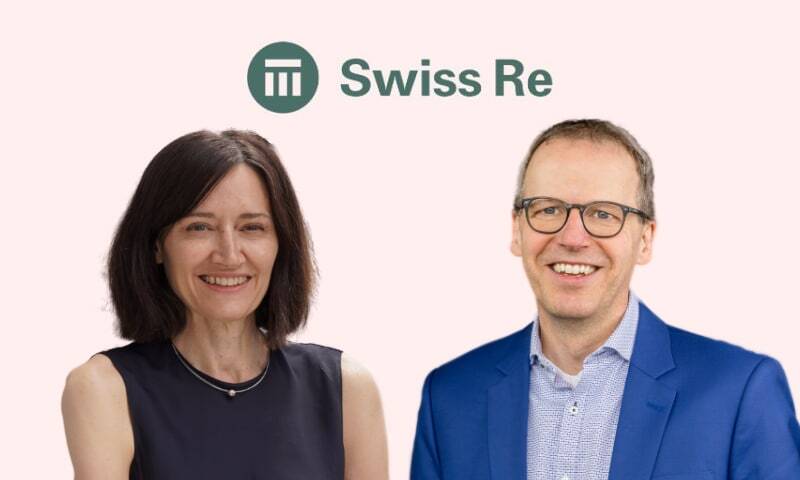 Artemis recently spoke to Balz Grollimund, PhD, Head of Catastrophe Perils, and Mariagiovanna Guatteri, PhD, Chief Investment Officer of Swiss Re Insurance-Linked Investment Advisors Corp. (SRILIAC), who both explained how Swiss Re’s in-house catastrophe modelling capability works in practice, and how it also supports investment decisions.
Across the reinsurance space, Swiss Re is a very well-known name. However, within the insurance-linked securities (ILS) industry, the firm is known for being both an issuer or fund manager for ILS. We asked the executives what this multi-faceted role means for ILS investors.
“Swiss Re, as a group, has a Catastrophe Perils team, which develops in-house natural catastrophe models that support all its risk taking activities. SRILIAC (the ILS fund management arm of Swiss Re) can access that insight directly, meaning that we have access to the same risk models to support investment decisions that Swiss Re uses as a basis for underwriting,” Guatteri told Artemis.
She continued: “So investors know that we have a consistent risk view that strengthens our alignment of interests, as the models and guidance we’re using are the same used by Swiss Re to take risk decisions for its own balance sheet. And of course, the risk information is proprietary.”
In regard to how these cat models are produced, Swiss Re’s team has more than 50 scientists who are directly involved on the production side.
According to Grollimund this team consists of PhDs and specialists across the relevant scientific disciplines: seismologists, hydrologists, atmospheric scientists, as well as engineers who help the firm understand how hazards translate into physical damage and financial loss.
“That scientific inhouse capability is complemented by dedicated technology and IT teams who support model development and implementation. But what I think really creates an edge is that the team understands how the models are actually used. Many rotate through underwriting or work closely with investment and portfolio management teams, so there is a constant feedback loop between model development and every-day application/ use,” Grollimund said.
The executives then outlined why it matters for investors whether investment team use the same models as underwriters.
Guatteri, explained: “We’ve covered how this allows for a consistent risk view and can contribute to the alignment of interests. The other advantages are transparency, consistency and speed.
“In practice, when the Cat Perils team issues a model update or new guidance — whether following a catastrophe event or reflecting new scientific or socioeconomic insights — that guidance is implemented directly into the tools we use for investment analysis in a consistent and timely manner, so we are not blindsided by sudden and infrequent model updates. We don’t need to adjust or second-guess the underlying risk views, because we’re so close to the team that produces them.
“And because our portfolios are already analysed within Swiss Re’s systems, we can rapidly assess potential portfolio and industry losses from live nat cat events, and react accordingly.”
Guatteri also explained how these models enable Swiss Re to explore perils which the ILS industry has not previously covered.
“As the catastrophe bond market expands into new perils and more complex structures, broad and credible modelling coverage becomes increasingly important. Swiss Re’s internal models allow us to analyse a wider range of risks — including secondary perils — and to assess structures that may be less standardised.
“What’s important for us and for investors is that it actually expands the investable universe while maintaining a well-understood risk-return profile, which is ultimately what institutional investors should care about,” Guatteri said.
Providing further context, Grollimund shared how Swiss Re’s risk views differ from commercial vendor models.
“The most important thing to keep in mind is that catastrophe models are never perfect, and each new event comes with learnings. This is why it is crucial to respond quickly to events, to check whether new insights have been provided by events that warrant a model adjustment, and to update the model quickly if that is the case,” Grollimund said.
“For investors, the key point is not that one model is “right” and another is “wrong”, but how quickly and pragmatically insights are incorporated into risk decisions.”
2025 saw a number of severe convective storm events take place in Europe, which led to a number of losses that surprised the reinsurance market. However, according to Grollimund, in many cases, the issue was not the hazard model itself, but the data that was feeding into it.
“Exposure data often failed to capture recent changes, such as the rapid installation of photovoltaic panels or modern insulation materials, which turned out to be highly vulnerable to hail damage. If sums insured and building characteristics are not up to date, losses will be underestimated,” he said.
“This underlines the importance of understanding not just the model, but the whole process to form a risk view, including the quality and completeness of exposure data and underlying loss estimates that are used to calibrate the model.”
Despite their advantages, proprietary models are sometimes criticised as ‘black boxes’ due to their opaque nature. We asked the executives how Swiss Re addresses these concerns
“For those using them, a proprietary model is the opposite of a black box,” Guatteri said.
“Swiss Re’s models are fully transparent internally, with direct access to event sets, hazard footprints, assumptions, and — critically — the teams that design, maintain, and review them. That allows us to understand the drivers of risk and to engage directly with the modelling process. And to Balz’s point just now: it helps us that we can understand not just the model itself but also the quality and completeness of the source data. We know where limitations are.
“For end-investors, different risk views can be benchmarked using common reference portfolios, such as the catastrophe bond market, so that investors can assess relative differences in risk assessment and outcomes across modelling approaches,” she added.
To end, Grollimund shared how he sees catastrophe modelling evolving over the next few years, and what investors should expect to see within the space too.
“The fundamental structure of catastrophe models is unlikely to change dramatically in the near term. But there is significant potential to improve how models are built, maintained, updated and integrated into underwriting processes,” Grollimund said.
Concluding: “We are exploring ways in which advanced analytics and AI can help accelerate parts of the modelling process. The goal is not novelty, it’s faster, better-informed insights that improve underwriting and investment decisions. For investors, that ultimately can mean fewer surprises and a more disciplined approach to managing catastrophe risk.”
 View all of our Artemis Live video interviews and subscribe to our podcast.
All of our Artemis Live insurance-linked securities (ILS), catastrophe bonds and reinsurance video content and video interviews can be accessed online.
Our Artemis Live podcast can be subscribed to using the typical podcast services providers, including Apple, Google, Spotify and more.