



Acceptance of insurance-linked securities (ILS) is now widespread in the reinsurance market, and as the asset class consistently proves itself as a stable partner and investor demand remains high amid attractive risk premium, Integral’s quantitative and transparent approach continues to gain traction.
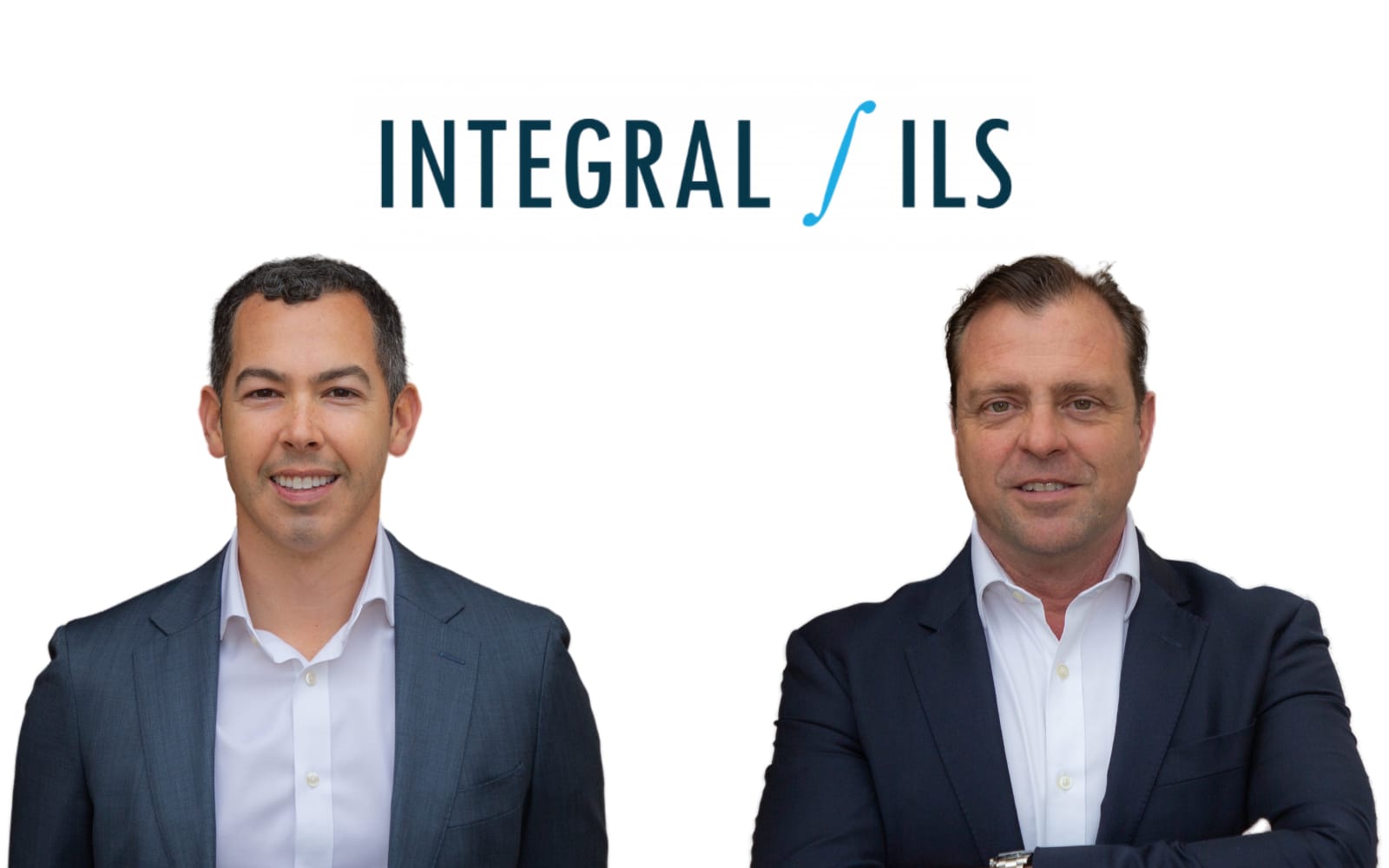 Artemis recently met with Richard Lowther, Co-Founder and Managing Partner and Kristofer Sannemalm, Head of Underwriting for Integral ILS, at their office in Bermuda, to discuss market trends and Integral’s approach as the manager’s assets under management sits at a healthy $3.5 billion as of January 2026.
According to recent analysis from brokers, alternative capital now accounts for 15-20% of total dedicated reinsurance capital, and most traditional carriers now have an ILS platform of some form.
“The acceptance of the asset class is widespread, and ILS has consistently proven itself,” said Lowther. “It has been a stable partner, paid claims quickly, and has not been litigious. I think that was a critical angle for a lot of traditional insurers and reinsurers, but ultimately, we’ve proven that our support is seamless and we are here after an event to trade forward. And then, the investors are sophisticated, they understand the risk that they support, and will reload if the market opportunity is attractive.”
The ILS space continues to attract new investors seeking diversification and low correlation with the broader financial markets, while many investors have now been participating in ILS for quite some time.
Lowther explained that, historically, ILS worked best when you had a champion within a large pension or sovereign wealth fund, or large allocator, that revalued the attributes of an asset class that is based in physical science, such as climatology and seismicity.
Today, Lowther feels that the asset class has evolved with more sophistication at the broker level in matching risk to various ILS market appetites, as well as consultants having a better understanding of the unique attributes of ILS platforms to guide their client’s investment strategies.
“We’re a signatory to the Standards Board for Alternative Investments; they’ve done a lot of work on valuation and side pocketing toolkits and transparency in general. So, it is much easier now for an allocator not to have to become this in-house champion or specialist, but rely on broader industry participants and have greater access to educational resources,” said Lowther.
Expanding on this, Sannemalm emphasised that the structural maturity of the asset through its strong track record and industry adopted catastrophe risk models means that today, “the due diligence process is more streamlined and comprehensive to better highlight the bespoke advantages each manager brings to the table, and whether they align with a client’s investment philosophy.”
Over the years, transparency has improved in the ILS space, but while it’s important to work with investors to give them what they want, Lowther stressed that tailoring based on individual client needs is critical as one size of reporting does not necessarily fit all.
“We never see our investors as a competitor to Integral. They are busy, highly intelligent people that cover a wide array of different asset classes. But I think they just need to build a level of trust, which can be earned through transparency and reporting. We have our back office administrator who provides quarterly transparency reporting, we get independent actuaries to conduct periodic valuation reviews and provide those to clients. Our ILS funds have a strong, independent board of substantive non-executive directors with decades of experience. So, we build layers of governance, and I think that really helps make it more institutionally robust,” he said.
Integral ILS launched in July 2020 with strategic support from TransRe and Amwins, and with approximately $600 million in AuM following its first investor commitments in November of that year. As of January 2026, the AuM stands at $3.5 billion.
“We founded Integral with a vision of building a platform that we hope would evolve the asset class. We started with risk distribution and capital efficiency. My business partner and our Co-founder, Lixin Zeng, is an atmospheric scientist. He has a relentless commitment to understanding climate risk, a very quantitative approach, which a lot of our investors really like, as well as our cutting edge portfolio optimization tools.
“We have a very diverse investor base across Australia, the US, Canada, Switzerland, and Northern Europe. We’re not only a diverse investor base as far as the geographic spread, but also the risk-return profile, including a range of efficient frontiers created by accessing multiple forms of property catastrophe risk. We specialize in Funds of One, which we set up very quickly and efficiently. So, for large allocators, they appreciate the speed to market, and cost savings through the structuring process. We can offer a bespoke return profile, which investors find really helpful,” said Lowther.
“And as well, the most critical bit is the team. We were grateful to attract a founding group with broad skillsets to drive our platform vision, and people who quit their day job when we had zero assets under management. To date, touch wood, everybody has stayed. One of the things we identified early on with challenges that the market was facing was operational instability. We still see it with some managers, particularly the affiliated managers, who I think struggle to keep the talent in place, and critical for us was to have a happy team,” he added.
Building on Lowther’s comments, Sannemalm highlighted that Integral has access to a global opportunity set of risks through their direct market relationships and business partners TransRe and Amwins.
“Having the ability to support various products in the property landscape allows us to target risks through different market cycles, collaborate on strategic multi-product initiatives and most importantly, have confidence in execution of target fund profiles.” he said.
In terms of a target AuM, Lowther told Artemis that he believes Integral is scalable to grow significantly beyond where it is today. But while the ILS manager is keen to expand further, Lowther was clear that it does ultimately always come down to the opportunity set for investors. “We’re not afraid to return capital if the market opportunity is that we can’t deliver on the promises to investors,” he said.
As our readers will be aware, rates in the reinsurance and ILS market have come off of historical highs, but importantly, Integral is still seeing attractive risk premium in the market.
“As a result of the volatility elsewhere in broader financial markets, instability in general and inflation coming back, ILS is still seen as an attractive asset class to be invested in, and it continues to prove its low correlation benefit time and time again,” said Lowther.
A reason for the ILS sector’s continued attractiveness, according to Sannemalm, lies in its evolution as an asset class over the past 20 years.
“Our asset class has grown to provide multiple, differentiated investable products to meet the needs of both protection buyers and investors. Given our breadth and size, we expect that even if there is a dislocation, or a market changing covered event, we consider the ILS market to be resilient and in a position to offer creative solutions to trade forward,” he said.
To end, we asked for their thoughts on the trends most likely to impact ILS returns over the next three to five years.
“We do think that the peaks and the troughs of the cycle are compressing. And again, there’s not a lot of data points, so one has to be careful, but certainly, the speed of the cycle is faster. And we believe and hope that it’s true that the peak to trough is not only faster, but also more compressed. To me, this reflects the market’s sophistication and investors’ ability to increase or reduce their allocations in response to different phases of the market cycle.”
Read all of our interviews with ILS market and reinsurance sector professionals here.
 View all of our Artemis Live video interviews and subscribe to our podcast.
All of our Artemis Live insurance-linked securities (ILS), catastrophe bonds and reinsurance video content and video interviews can be accessed online.
Our Artemis Live podcast can be subscribed to using the typical podcast services providers, including Apple, Google, Spotify and more.